Beginner
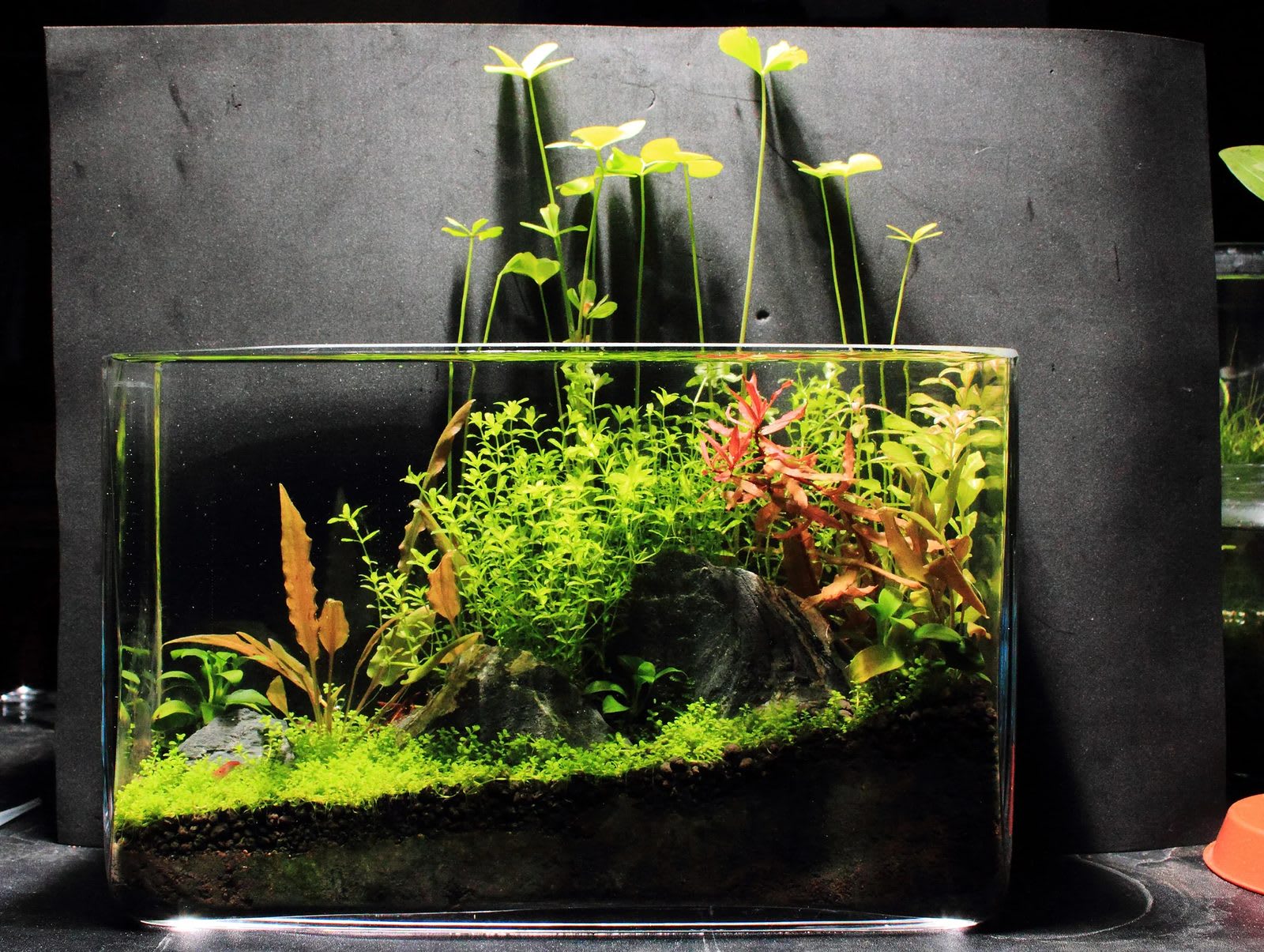
The Low-Tech Sanctuary
No CO2, easy plants, and a forgiving routine for busy aquarists.
Volume
60 L
Est. monthly cost
~$18
Water target
23–26 °C · pH 6.8–7.5
Overview
A balanced community tank with nutrient-rich soil, moderate light, and plants that thrive without injected carbon.
Choose hardy species: crypts, ferns, anubias on wood, and a few stem plants that accept Excel-style supplements if algae appears.
Filtration: hang-on-back or internal with biological media; aim for 4–6× turnover. Surface agitation helps oxygen without stripping too much CO2 from fish respiration.
Stocking stays conservative—small tetras, rasboras, or peaceful dwarf cichlids depending on water chemistry. Feed once daily, fast one day per week.
Step-by-step setup guide
Tank & substrate preparation
Day 1Place the 60 L tank on a solid stand near a power outlet but away from windows (direct sun promotes algae). Use nutrient-rich aquasoil as the base substrate—low-tech plants benefit from root feeding since there's no CO2 to accelerate water-column uptake. Layer 3–4 cm, with a gentle back-to-front slope.
- ▸Aquasoil + no CO2 = reliable growth for crypts and swords that feed through roots.
- ▸Add a thin layer of fine gravel on top to prevent soil from clouding during water changes.
Hardscape arrangement
Day 1Add a medium piece of driftwood (Mopani or Dragon stone) as a focal point. Keep it simple—one main piece with perhaps one accent stone. This build prioritizes the lush plant growth over dramatic hardscape. Position the wood off-center and leave open planting areas in front and to the sides.
- ▸Driftwood provides attachment points for Anubias and Java fern, maximizing plant variety without extra substrate.
- ▸Boil or soak wood beforehand to prevent floating and reduce initial tannin release.
Planting the low-tech garden
Day 1–2Attach Anubias nana to driftwood using super glue gel. Tie Java fern to any remaining wood or stone. Plant Cryptocoryne wendtii in mid-ground clusters of 3–5 plants. Place Vallisneria in the back corners—it will send runners and create a natural curtain. Consider adding a few stems of Bacopa or Hygrophila for vertical variety; these tolerate low-tech conditions well.
- ▸Never bury Anubias or Java fern rhizomes—they rot. Glue or tie them to surfaces.
- ▸Vallisneria is an aggressive spreader; pull runners monthly to control placement.
- ▸Start with more plants than you think you need—it reduces algae pressure from day one.
Equipment installation
Day 2Install a hang-on-back (HOB) filter rated for 4–6× turnover (240–360 L/h). HOBs provide excellent surface agitation for oxygenation, which is especially important without CO2 injection. Set up a 50 W heater to maintain 24–25 °C. Use a basic LED light on a timer for 7–8 hours daily—moderate intensity is the sweet spot for plant growth without algae explosion.
- ▸Stuff the HOB with ceramic bio rings instead of disposable cartridges for better biological filtration.
- ▸A timer is non-negotiable—inconsistent light schedules invite algae.
Cycling
Week 1–3Fill with dechlorinated tap water. Add a bacterial supplement to kickstart the nitrogen cycle. Dose a small amount of liquid fertilizer (half the recommended dose) from week 1 to feed plants during the cycle. Perform 30% water changes every 3 days. Test ammonia and nitrite weekly. The tank is cycled when both read zero for two consecutive tests.
- ▸With nutrient-rich soil, expect a brief ammonia spike in week 1—this is normal.
- ▸Plants growing during the cycle are actively consuming ammonia, helping it finish faster.
First fish & algae crew
Week 3–4Start with hardy species: 8 Harlequin rasboras and 4 Panda corydoras. These are forgiving of new-tank conditions. Add 3–5 Nerite snails as the algae cleanup crew. Drip-acclimate for 30 minutes. Feed once daily with high-quality flake or micro pellets; the Panda cories will appreciate sinking wafers at night.
- ▸Nerite snails won't breed in freshwater—no population explosion risk.
- ▸Fast the tank one day per week; it improves fish health and reduces waste.
Building the community
Week 5–6After 2 weeks of stable parameters, add the remaining stock. Important: Neon tetras and Panda cories prefer soft, slightly acidic water (pH 6.0–7.0), while Guppies thrive in harder, alkaline water (pH 7.0–7.8). Pick ONE chemistry direction—either add 8 Neon tetras (and skip guppies) for a soft-water community, or swap to 4–6 Endler's livebearers or Platies if your tap water is hard. Avoid mixing soft-water tetras with guppies long-term: one side is always compromising.
- ▸Male-only livebearers if you don't want fry—or embrace breeding and let nature balance the population.
- ▸Total fish load for 60 L: aim for no more than 20–25 small fish (this is a low-tech tank without CO2-driven oxygen boost).
The forgiving routine
Month 2+This build is designed for busy aquarists. Weekly: 25–30% water change, wipe front glass, trim fast-growing stems. Bi-weekly: dose liquid fertilizer at half-strength, add root tabs near heavy feeders (crypts, swords). Monthly: rinse mechanical filter media in old tank water, test nitrate (keep under 20 ppm). The low-tech sanctuary becomes more beautiful with age as plants fill in and find their balance.
- ▸If algae appears on slow-growing leaves, reduce light to 6 hours for 2 weeks rather than adding chemicals.
- ▸Liquid carbon (Excel/Easycarbo) can be used as a spot-treatment for stubborn algae—apply with a syringe during water change.
Maintenance schedule
Weekly: 25–30% water change, wipe glass, trim fast growers. Monthly: rinse mechanical media, test nitrate trend.
Suggested catalog links
Each link opens its catalog page. Import adds the fish and plants to My Tank; add the gear you already run there.
Import to My Tank
Applies tank volume, temperature, pH, light, CO₂ flag, and substrate from this blueprint, then adds any fish, plants, and equipment rows that match listed slugs or equipment ids in the live catalog.