Biotopes
Discover habitat-style tank setups with region data and typical species.
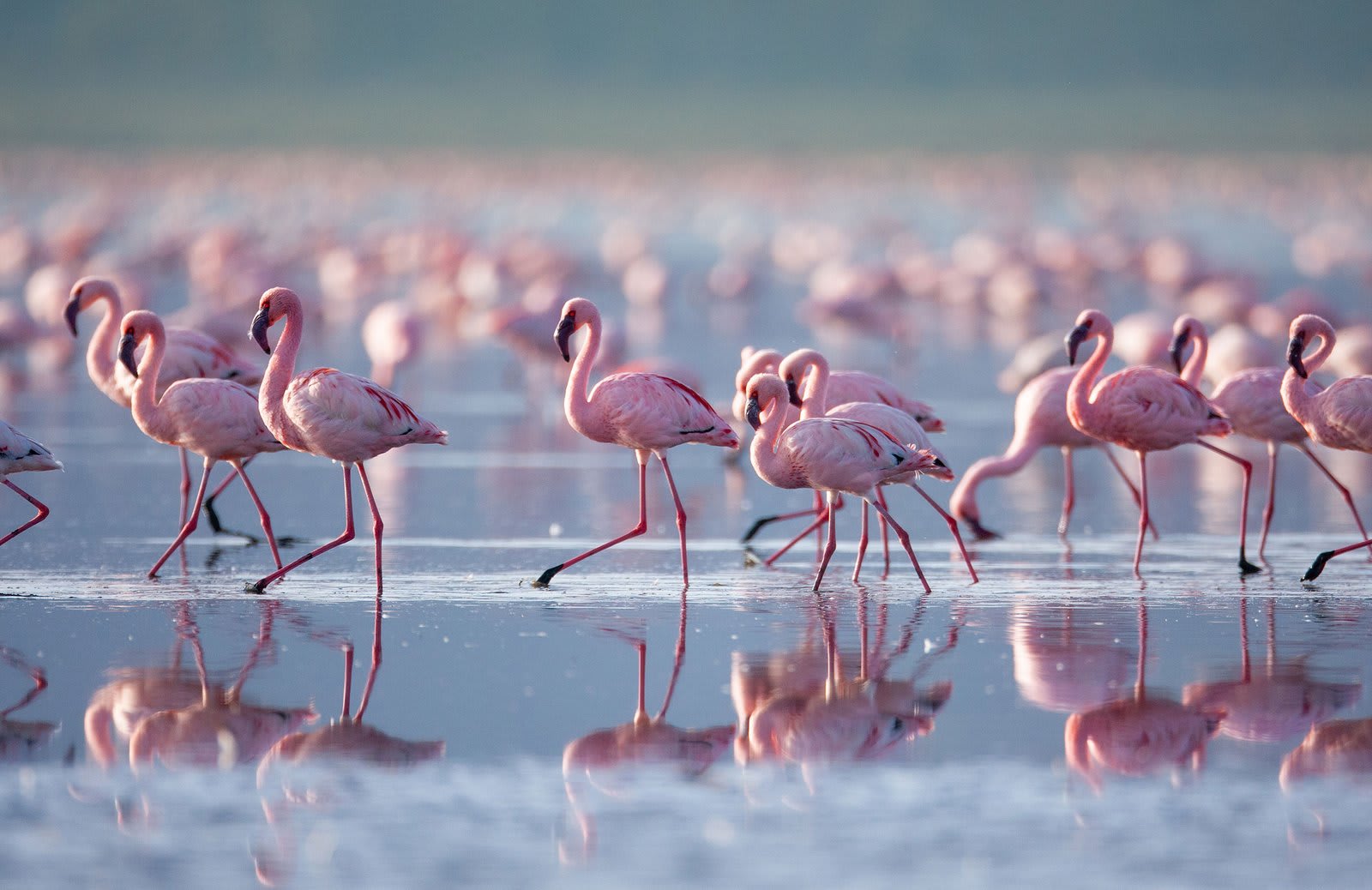
African Rift Lake (Tanganyika / Malawi)
East Africa — Lakes Tanganyika and MalawiLake Tanganyika is 673 km long, 50 km across at its widest, and 1,471 m deep at the trough — the second deepest freshwater body on the planet, older than the Amazon basin in its current form by an order of magnitude. Nine to twelve million years of isolation have produced roughly 250 endemic cichlid species along its shoreline; that radiation, with Lake Malawi's parallel one to the south-east, is the single largest natural laboratory for vertebrate speciation known. Water at the surface holds at 24–27°C year-round, pH 8.6 to 9.0, conductivity around 600 µS/cm, with calcium and bicarbonate buffering that makes the lake feel closer to dilute seawater than to a river. Below 200 m the water is anoxic and unchanging; above it, life crowds the rocky shore in concentrations that no aquarium can imitate. Each dry season — May to September — south-easterly trade winds push surface water toward the lake's north-west, and cold, nutrient-laden water upwells along the eastern shore. Diatom blooms follow within weeks; *Stolothrissa* sardines spawn against the plankton pulse; cichlids feed, court and breed in step. Shell-dwelling *Neolamprologus multifasciatus* defend territories barely larger than a man's hand, using the empty shells of an endemic snail, *Neothauma tanganyicense*, as cradle and fortress. *Tropheus* graze algae from boulders in tight matriarchal groups; *Cyprichromis* hover in mid-water columns hundreds strong, mouths catching plankton drifting through. The shoreline belongs to four countries — Tanzania, the Democratic Republic of the Congo, Burundi, Zambia — and to Bantu fishing peoples (Bembe, Holoholo, Tabwa) whose night fishery for *dagaa* (the local name for that sardine) once landed over 200,000 tonnes a year. Catches have nearly halved since the 1990s as warming has slowed the upwelling cycle that feeds the lake. In a Tanganyika aquarium the conventional aesthetic — aragonite sand, a wall of holey rock, no plants — is correct, but austerity is not the point. The point is the water column itself: clear, hard, alkaline, oxygen-saturated, indifferent. Cichlid colour, behaviour and shape are how the lake speaks back. Sources: Coulter, *Lake Tanganyika and Its Life* (1991); O'Reilly et al. *Nature* on Tanganyika warming and productivity (2003); FAO assessments of the Lake Tanganyika sardine fishery.
Temp: 24-27 CpH: 7.8-9Fish: 1Plants: 1
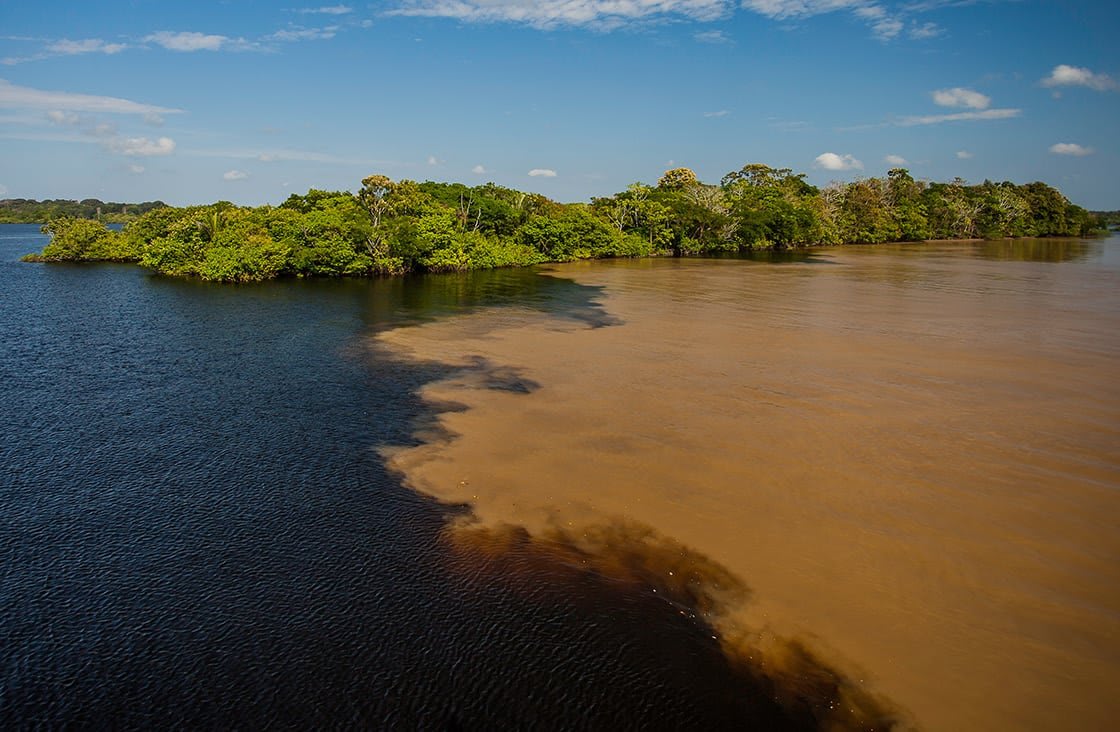
Amazon Blackwater
South America — Amazon and Rio Negro basinsThe Rio Negro meets the main Amazon stem just west of Manaus, but its source is 1,700 km north of that confluence, in the iron-rich highlands of the Guiana Shield. Tannins leach from the surrounding forest as rain filters through leaf litter and humic soil, staining the water the colour of weak black tea. Light penetration drops below 1% by 50 cm of depth — the word *blackwater* in aquarium shorthand comes from this, the swallowed sun. pH settles between 4.0 and 5.5, conductivity rarely climbs above 10 µS/cm, and the water carries almost no dissolved calcium. Day-time surface temperature sits at 26–28°C; nights at 24°C are considered cool. Each year the river rises 8 to 10 metres. During high water the floodplain forest — *várzea* — disappears beneath an inland sea, and characins follow the flood into the canopy, feeding on fruit that drops directly to the fish below. As the water retreats, isolated pools called *igapó* concentrate the season's spawn into shrinking volumes; herons, kingfishers and electric eels harvest the surplus. The schooling reflex of cardinal and neon tetras, the cryptic colouration of corydoras and apistogrammas, the slim profile of pencilfish slipping between flooded roots — every one of these traits is a reply to that annual cycle of plenty and pressure. The *ribeirinhos*, river-bank communities along the Negro, still read the water level for their fishing calendar: high water for the big pirarucu, low water for turtles and arapaima fry. Upstream dams completed since the 1980s — Balbina on the Uatumã, Belo Monte on the Xingu — have dampened the flood pulse on parts of the basin, with effects that propagate downstream in ways scientists are still measuring. A 120-litre blackwater aquarium with catappa leaves, three pieces of driftwood and the light dimmed is not a copy of the Negro. But it preserves the grammar of the place: low light, soft acid, the tannic veil, and a geometry of hiding. Sources: Goulding et al. *The Smithsonian Atlas of the Amazon* (2003); Latrubesse et al. *Geomorphology* on Amazon várzea (2008); Junk et al. *Aquatic Ecosystem Health & Management* on the flood pulse concept.
Temp: 24-28 CpH: 4-5.5Fish: 13Plants: 3
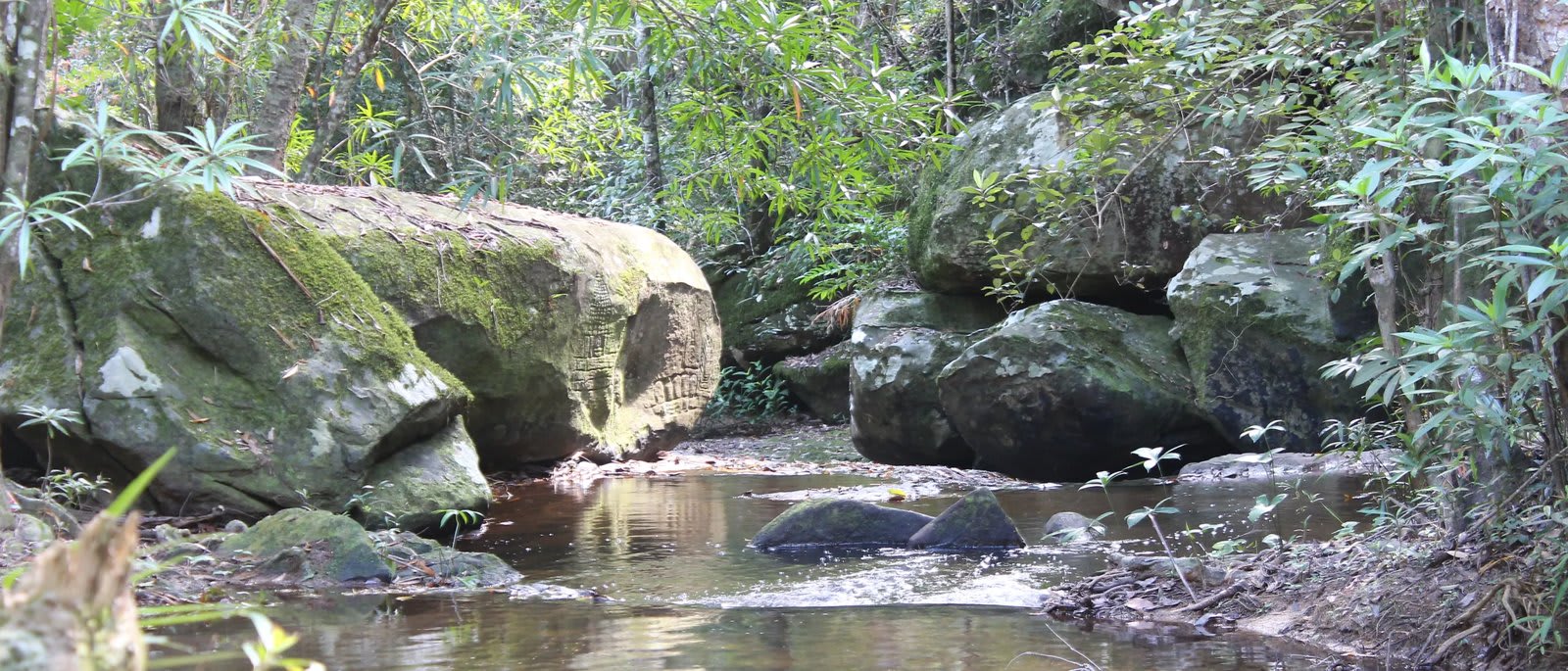
Southeast Asian Stream
Southeast Asia — Borneo, Sumatra, Peninsular Malaysia, southern ThailandTake a stream in the lowland rainforest of southern Sarawak or the Endau-Rompin park of Johor: sandstone bedrock, ten to thirty metres wide, knee-deep in the dry season, doubling under monsoon rain. Leaves fall from *Shorea* and *Dipterocarpus* trees overhead, settle into rifts in the rock, and turn the water a clear amber — not the saturated black of the Negro, but enough tannin to soften it. pH 5.5 to 6.8, conductivity rarely above 80 µS/cm, daily temperature steady at 23–27°C. The biological signature is the genus *Cryptocoryne*: more than 80 species in the region, many endemic to a single river system, photographed in submerged forests on rock and sand. The north-east monsoon, October to February, drops over 60% of Borneo's annual rain in four months. Streams that ran shin-deep can move boulders. Rasbora harlequins, chili rasboras and *Boraras* schools hold in mid-water through the calm months and pull into rock shadow when the rain comes. Kuhli loaches braid through leaf litter at the substrate; sparkling gouramis defend bubble nests in still margins; *Parosphromenus* — the licorice gouramis, perhaps the most fragile of all anabantoids — wait beneath overhangs in water so soft it conducts nearly nothing. The *Cryptocoryne* themselves do something rare: they melt and re-emerge as the seasons shift, a strategy that keeps the rooted plant in step with the forest around it rather than against it. The Iban and Dayak peoples of Sarawak still name fish by river: *ikan tilan* for the kuhli loaches in their flow, *puyu* for the climbing perch of slower pools. The forests that shade those rivers have lost roughly 30% of Borneo's lowland canopy and 60% of Sumatra's to palm oil expansion since the 1980s. Cryptocoryne species are described and lost in the same decade. The aquarium answer is modest: a shaded tank with sandstone, leaf litter and *Cryptocoryne wendtii* or *parva* on the substrate, *Bolbitis* and Java fern on the wood, current that whispers instead of pushes. It carries the syntax of the place if not its scale. Sources: Jacobsen et al. *Aqua: International Journal of Ichthyology* on Cryptocoryne distribution; WWF/RSPO 2020 figures on Borneo and Sumatra forest loss; Tan & Lim, *The Ornamental Fishes of Singapore*.
Temp: 23-27 CpH: 5.5-6.8Fish: 8Plants: 5