← Back to equipment catalog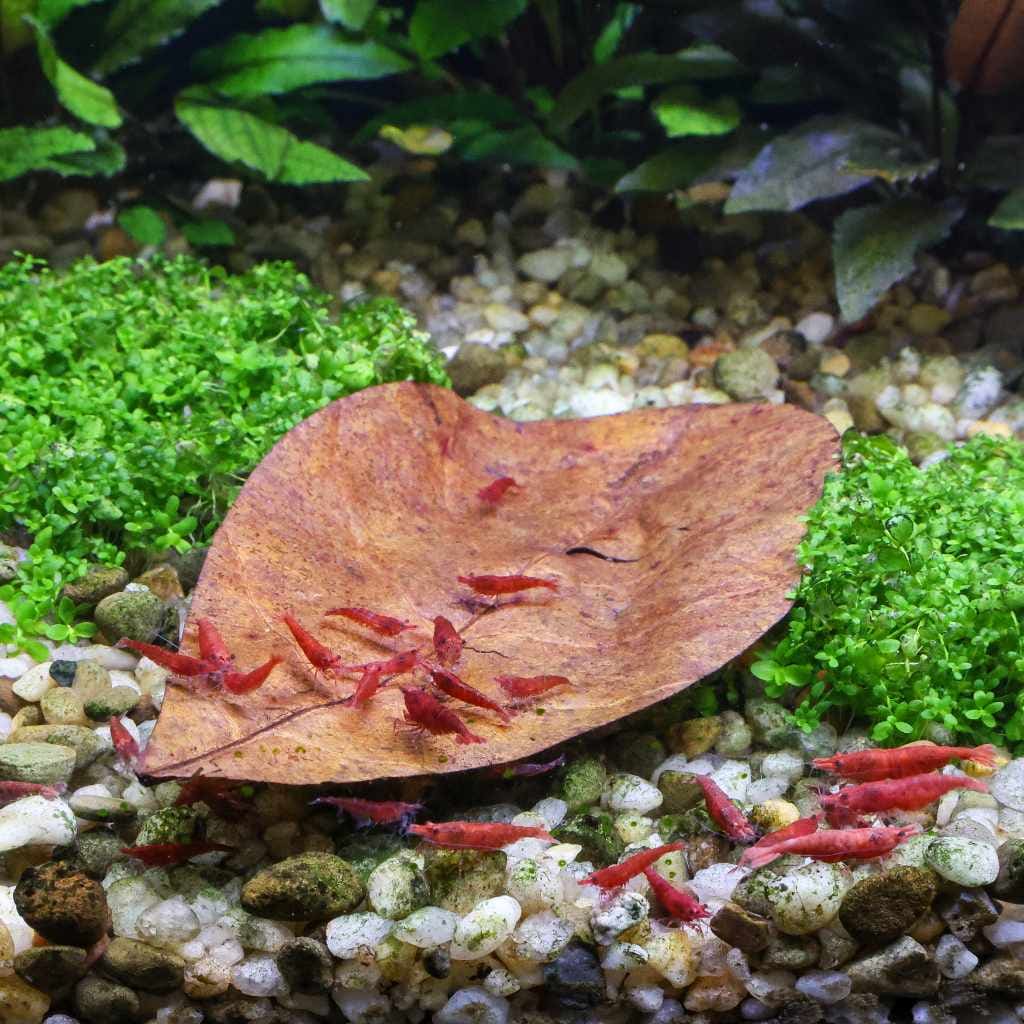
Hero image is from the maintained catalog (brand / product publicly-available assets or vetted stock). The physical product takes precedence.
Hardscape
Catappa leaves
hardscape
Used for: Blackwater tanks, Biotope tanks, Shrimp tanks, Tank maintenance
Description
The packet usually promises calm fish and better water. The one study that tested Indian almond leaves the way an aquarist actually uses them measured something narrower and more useful than that. Purivirojkul extracted powdered Terminalia catappa leaves in water at one part leaf to ten parts water, freeze dried the result, and tested it against 28 bacterial isolates taken from Siamese fighting fish, among them Aeromonas hydrophila, Edwardsiella tarda, Pseudomonas and Streptococcus. Two things came out. Red leaves beat green ones, with a minimum inhibitory concentration of 187.5 to 375 ppm for red against 375 to 750 ppm for green and the bactericidal figures ordered the same way. And the extract has a ceiling: the 96 hour LC50, the concentration at which half the test fish died, was 1,651 ppm for red leaf extract and 1,766 ppm for green. Set those beside each other and the leaf stops being a health food. The paper concludes that red leaf aqueous extract has potential for controlling pathogenic bacteria at 750 ppm, which it considers safe given the measured toxic level. That is a margin of roughly a factor of two. It is a normal margin for a drug and a strange one for something people drop into a tank by eye. A more recent study asked the question every keeper actually has, which is whether the leaves harm the biofilter. Working in vitro, it found methanolic leaf extract inhibited pathogens more strongly than it inhibited nitrifying bacteria, and its own conclusion is careful: the result is limited to in vitro confirmation and needs validation in live systems. Its phytochemical screen is where the tannins in the hobby's story turn up, alongside alkaloids, flavonoids, phenols and terpenoids. What no one has published is a leaves per litre figure. The old description's soothing, healing and antifungal claims are gone with it.
Sources
- pubmed.ncbi.nlm.nih.gov — https://pubmed.ncbi.nlm.nih.gov/23885412/
- pubmed.ncbi.nlm.nih.gov — https://pubmed.ncbi.nlm.nih.gov/42515894/
Figures on this page were read off these pages. Manufacturers and databases do change or retire pages; if a link is dead, tell us with the correction link below.
Keep this species? Spot anything off?