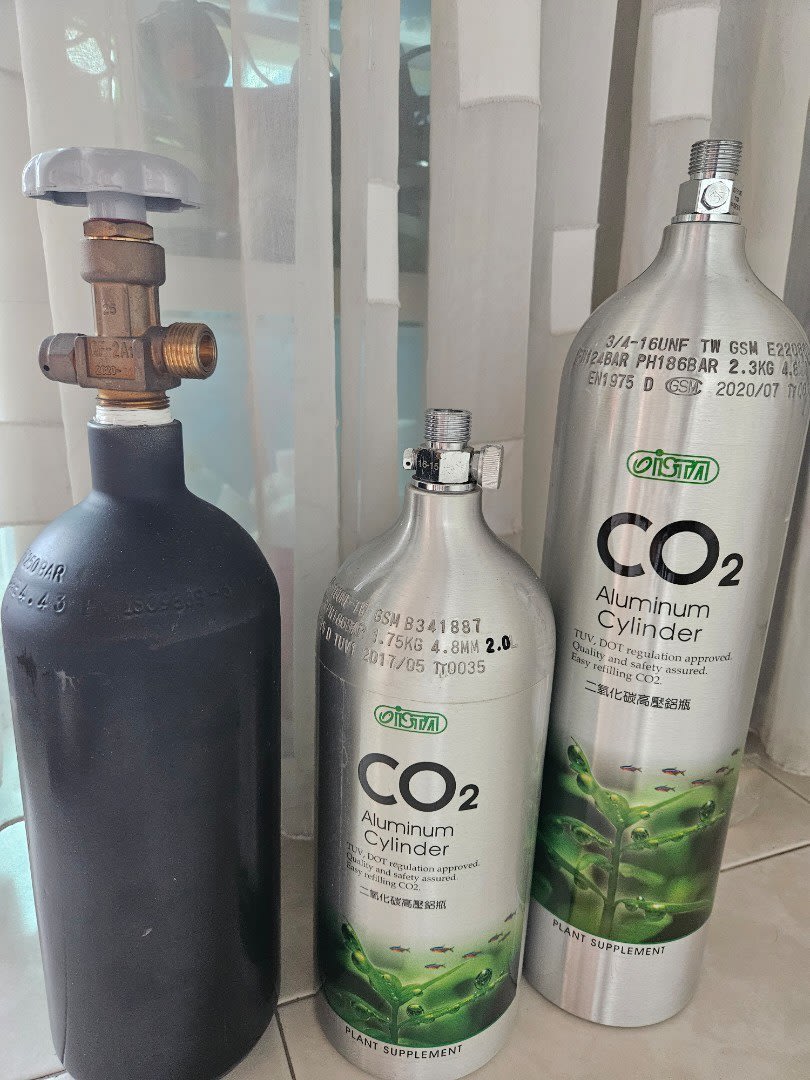
Representative photo. The product you buy may differ in size, colour or packaging.
CO2 cylinder
co2
Used for: Planted tanks, CO2 injection
Description
A CO2 cylinder is a pressure vessel before it is aquarium equipment, and it is the one item in a planted tank that United States law treats as a transport package. Each cylinder used for the transportation of hazardous materials must be an authorized packaging, and the rules that decide whether a shop will fill one sit in title 49 of the Code of Federal Regulations rather than in any aquarium manual. Two of them are worth knowing before handing a cylinder across a counter. Before each filling of a cylinder, the person filling the cylinder must visually inspect the outside of the cylinder, and a cylinder that has a crack or leak, is bulged, has a defective valve or a leaking or defective pressure relief device, or bears evidence of physical abuse, fire or heat damage, or detrimental rusting or corrosion, may not be filled and offered for transportation. The same part adds that a cylinder is not filled to the brim: sufficient outage must be provided so the cylinder will not be liquid full at 55 degrees C, and the pressure of the contents at that temperature is capped against the cylinder's own service pressure. The second rule is the requalification date marked on the cylinder. Each cylinder bearing a DOT, CRC, BTC, or CTC specification marking must be requalified and marked as specified in the requalification table, and except as otherwise provided in this subpart, each time a cylinder is pressure tested, it must be given an internal and external visual inspection. In that table an aluminium 3AL cylinder reads 5 or 12 years. The same section then carries paragraph (j), headed Cylinder used as a fire extinguisher, and paragraph (m), which covers DOT-3AL cylinders manufactured of 6351-T6 aluminum alloy and says in its own words that it does not apply to cylinders used for carbon dioxide, fire extinguisher, or other industrial gas service. Which period governs a particular cylinder is the requalifier's call. A cylinder can also fall due early. Without regard to any other periodic requalification requirements, it must be tested and inspected before further use if it shows evidence of dents, corrosion, cracked or abraded areas, leakage, or any other condition that might render it unsafe for use in transportation, and once a requalifier rejects one, the owner must be told in writing and the cylinder may not be filled with a hazardous material and offered for transportation where use of a specification packaging is required.
Sources
- ecfr.gov — https://www.ecfr.gov/current/title-49/subtitle-B/chapter-I/subchapter-C/part-173/subpart-G/section-173.301
- ecfr.gov — https://www.ecfr.gov/current/title-49/subtitle-B/chapter-I/subchapter-C/part-180/subpart-C/section-180.205
- ecfr.gov — https://www.ecfr.gov/current/title-49/subtitle-B/chapter-I/subchapter-C/part-180/subpart-C/section-180.209
Figures on this page were read off these pages. Manufacturers and databases do change or retire pages; if a link is dead, tell us with the correction link below.
Was this page useful? Spot anything wrong?