← Back to equipment catalog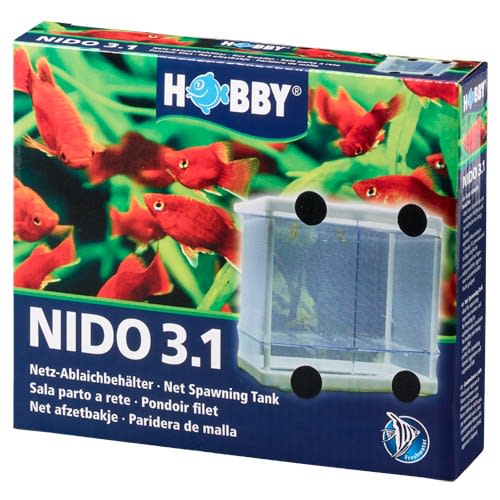
Hero image is from the maintained catalog (brand / product publicly-available assets or vetted stock). The physical product takes precedence.
Accessories
Floating breeder net
accessory
Used for: Breeding tanks, Tank maintenance
Description
A floating breeder net is a mesh box hung inside a tank so that small fish can be kept in the same water as everyone else without being in reach of them. Two laboratory papers use the object, for two different jobs, and each says what for. The first is protecting newborns. In a study of gonad development in the mosquitofish Gambusia holbrooki, a livebearer, females with known gravid spot intensities were individually allocated to a static tank set up with a breeding trap to protect neonates from cannibalisation. The risk being guarded against is named in that sentence: the young being eaten. The second is separating adults. In a zebrafish toxicity study, breeding female fish were selected and maintained separately in fish breeding nets inside the same tanks, in order to avoid continuous spawning. The phrase worth keeping is inside the same tanks. The fish is held apart while the water it sits in stays the tank's own. FAO's manual on the artificial propagation of warm-water finfishes describes the pond version, hapas, which it defines in a parenthesis as rectangular boxes made of close-meshed netting cloth, fixed in ponds and used there for induced spawning, and elsewhere as cloth enclosures in which collected eggs and larvae are held for temporary holding and conditioning before transport. One caution travels with the object, and it is about the fish rather than the net. FAO's chapter on hatchery rearing of tilapia eggs and fry explains that a mouthbrooder under confinement may behave differently: if the brooder delays the release of her clutch, for example under high stocking densities, or releases the fry for only short periods for feeding, they may begin to lose condition, so if naturally reared fry are collected from hapas, tanks or other confined production systems, they may be sub-optimal for their age. The chapter's own preference for the next stage is plain: tanks are ideal for nurturing early fry, where feeding can be closely monitored, health checked, and predators kept out to ensure high survival. None of these sources publishes a mesh size, a net volume or a stocking density for an aquarium breeder net, so this page publishes none.
Sources
- pmc.ncbi.nlm.nih.gov — https://pmc.ncbi.nlm.nih.gov/articles/PMC10215382/
- pmc.ncbi.nlm.nih.gov — https://pmc.ncbi.nlm.nih.gov/articles/PMC8948799/
- fao.org — https://www.fao.org/4/AC742E/AC742E04.htm
- fao.org — https://www.fao.org/4/T8389E/T8389E11.htm
Figures on this page were read off these pages. Manufacturers and databases do change or retire pages; if a link is dead, tell us with the correction link below.
Keep this species? Spot anything off?