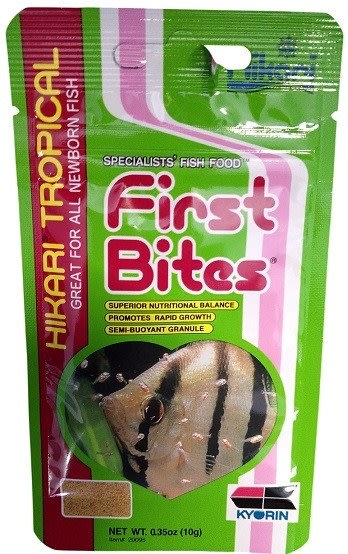
Representative photo. The product you buy may differ in size, colour or packaging.
Fry powder food
food
Used for: Breeding tanks, Tank maintenance
Description
Fry food is sold on how fine it is, and the reason is mechanical. FAO's manual on live food for aquaculture opens on the constraint: the mouth size of a first-feeding larva restricts the size of particle it can take in at all. The scale of that is easy to underestimate. A salmonid alevin at first feeding handles particles up to 1 mm. A first-feeding gilthead seabream larva manages 0.1 mm. Both are fish, both are eating for the first time, and one of them needs food a tenth the width of the other's. Size is not the only gate. Salmon alevins already have a developed digestive tract with working enzyme systems and can digest crumbles from the first meal. Seabream larvae, like many others, have no functional stomach at all, only a short gut with a few enzyme systems running. FAO sets out what such a larva needs from its food: it has to be at least partially and easily digestible, carrying free amino acids and oligopeptides rather than intact complex proteins, it has to contain enzymes that let the particle break itself down, and it has to supply the essential nutrients in quantity. Then comes the sentence a tub of powder has to answer for. Formulated feeds, FAO writes, generally do not meet all of those requirements and usually give poor growth and survival in small larvae. Live prey is also easier for a larva to find, having better contrast and a movement that triggers feeding.
Source
Figures on this page were read off these pages. Manufacturers and databases do change or retire pages; if a link is dead, tell us with the correction link below.
Was this page useful? Spot anything wrong?