← Back to equipment catalog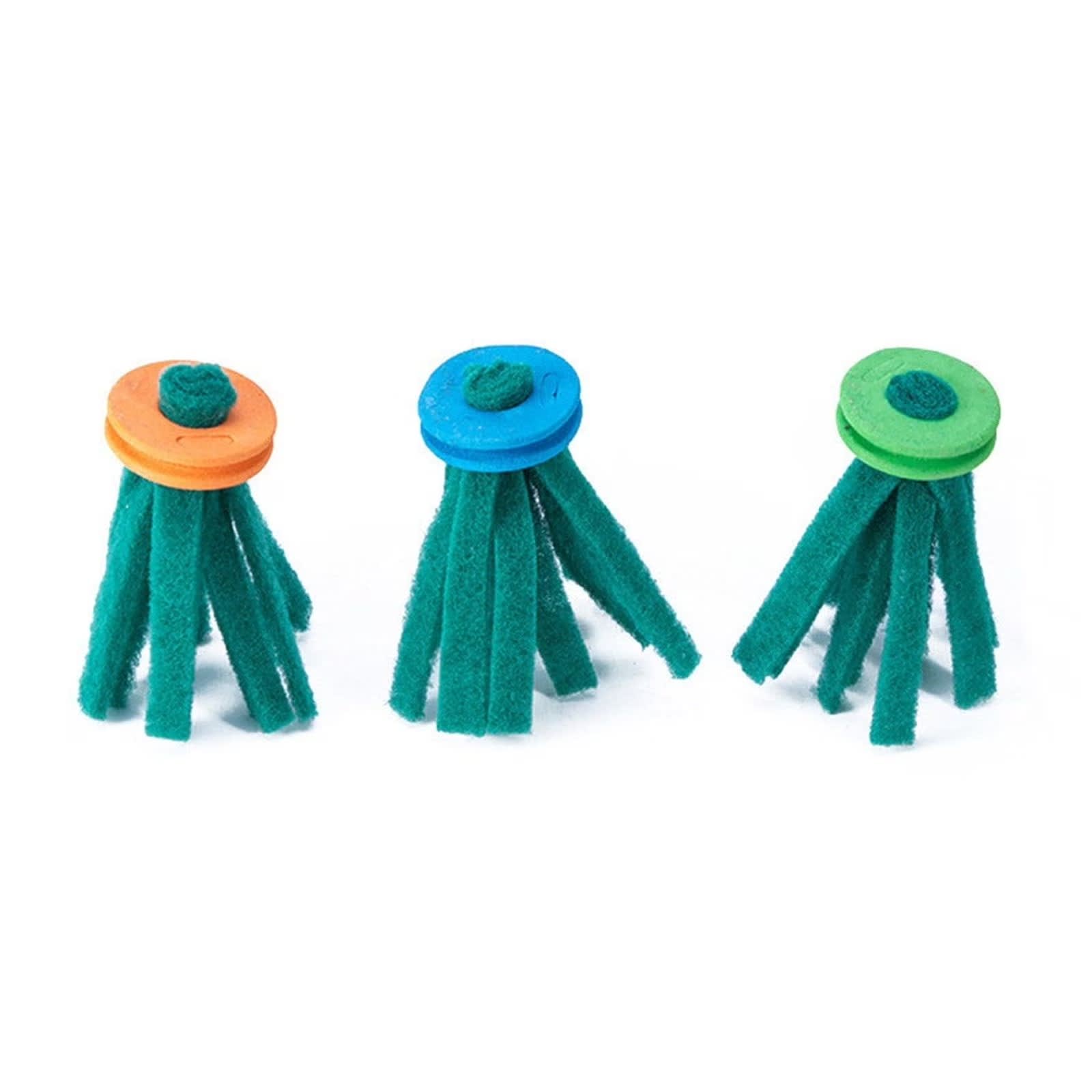
Hero image is from the maintained catalog (brand / product publicly-available assets or vetted stock). The physical product takes precedence.
Accessories
Spawning mop
accessory
Used for: Breeding tanks, Tank maintenance
Description
A spawning mop is a bundle of synthetic yarn that egg scattering fish lay on, and laboratories use it under exactly that name. Breeding killifish for a study of early cleavage, Dolfi, Ripa and Cellerino describe the object in one line: non-annual killifish were bred by floating an artificial floating bush made of acrylic wool strings (spawning mop) in the tank for 1 hour, and eggs were collected from the mop by hand. That is the whole of it. The mop is a surface the eggs stick to and a handle for lifting them out of the tank. A second group used one the same way on a different fish. Working with the dwarf neon rainbowfish, Miyamoto and co-authors kept each mature male and female pair in a tank with a spawning mop and found that each pair usually spawned every day. The spawned eggs were scattered on the spawning mops, and a female laid 10 to 20 eggs at once, which adhered to the mops via their filaments. That last clause is the mechanism: the attaching is done by the egg's own filaments. The mop can also be furniture rather than a collector. In a study of behavioural isolation between pupfishes, dominance studies were conducted to compare male aggressive behaviors during fights for breeding sites, and all trials were conducted in a 37-L aquarium with gravel substrate and a spawning mop in the center, to encourage territorial behavior. The same idea at pond scale is in FAO's manual on the artificial propagation of warm-water finfishes, which describes kakabans, artificial spawning surfaces that are made of dry grass, pine tree branches, or similar material fixed on a frame, and that are either fixed to the pond bottom with sticks, or are held about 20-30 cm below the water surface. The common carp of tropical and subtropical areas willingly spawn on kakabans, scattering their sticky eggs on this artificial surface, and they do not spawn in muddy bottomed ponds unless kakabans are provided. Afterwards the kakabans covered with eggs are removed from the pond and transferred to nursery ponds, where they hatch out and grow without the danger of becoming infected by parasites from their parents. FAO never uses the word mop, and the kakaban is cited here as the farm relative of the object rather than as evidence about yarn. None of these sources gives a yarn type, a mop size or a number of mops per tank, so this page gives none either.
Sources
- pmc.ncbi.nlm.nih.gov — https://pmc.ncbi.nlm.nih.gov/articles/PMC4177712/
- pmc.ncbi.nlm.nih.gov — https://pmc.ncbi.nlm.nih.gov/articles/PMC11656680/
- pmc.ncbi.nlm.nih.gov — https://pmc.ncbi.nlm.nih.gov/articles/PMC5809032/
- fao.org — https://www.fao.org/4/AC742E/AC742E04.htm
Figures on this page were read off these pages. Manufacturers and databases do change or retire pages; if a link is dead, tell us with the correction link below.
Keep this species? Spot anything off?