← Back to equipment catalog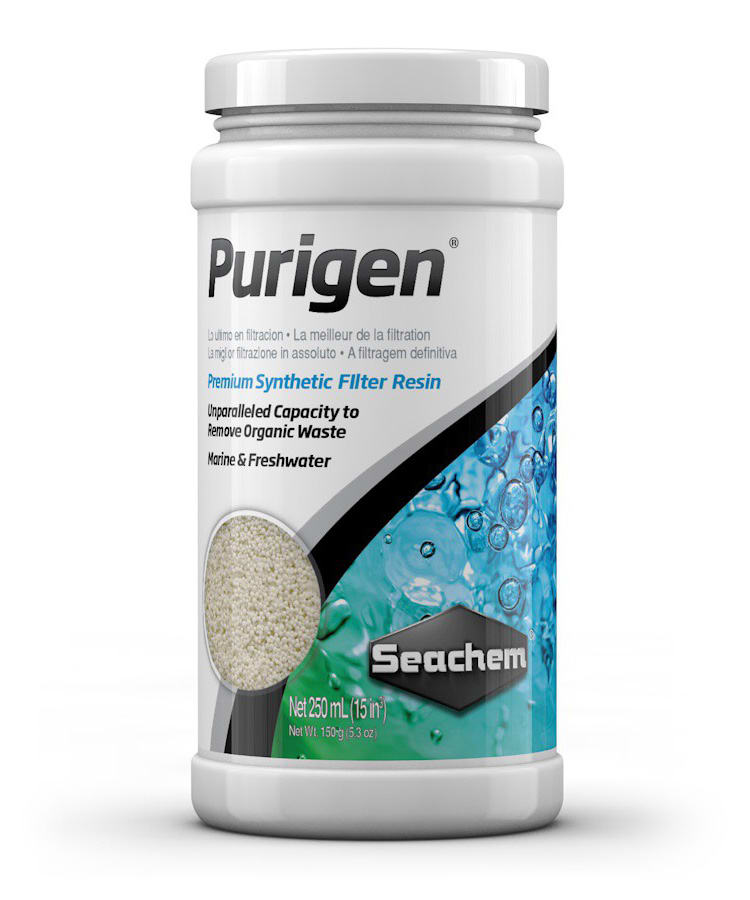
Hero image is from the maintained catalog (brand / product publicly-available assets or vetted stock). The physical product takes precedence.
Filtration
Organic Filtration Resin
Seachem Purigen
filter
Used for: Community tanks, Freshwater tanks
Specifications
| Specification | Value |
|---|---|
| Pack size | 100 mL, 250 mL, 500 mL, 1 L, 2 L, 4 L |
| Treats | Each 250 mL treats up to 1,000 L (250 US gallons) for up to six months |
| Form | Macro-porous synthetic polymer |
Values as listed by each source when checked on 2026-09-15. Listings change.
Description
Purigen is Seachem's organic filtration resin - a macro-porous synthetic polymer rather than the ion-exchange resin most competing media use. Seachem's claim is that it removes soluble and insoluble impurities at a rate and capacity exceeding competing products by over 500%, and that its impact on trace elements is minimal. The mechanism matters for how you use it. Seachem describes Purigen as controlling ammonia, nitrite and nitrate by removing the nitrogenous organic waste that would otherwise break down into them - it is not stripping those compounds out of the water column directly, and it is not a substitute for a cycled biofilter or for water changes. What it visibly does is polish the water and hold back the yellowing that builds up between changes. Dose and placement: rinse before use, run it in a fine mesh bag of 180 micron or less, and site it where flow is forced through rather than around it - a canister, a media chamber, or a high-flow section of a sump. Seachem rates each 250 mL for up to 1,000 L (250 US gallons) for up to six months. The resin starts pale blonde and darkens to brown or near-black; that colour change is the exhaustion indicator, which is why it is worth keeping it somewhere you can actually see. Regeneration is the reason people buy it, and the step most often skipped is the important one. Seachem's procedure is a 24-hour soak in 1:1 household bleach and water (regular 8.25% hypochlorite, unscented, no dyes, not splash-less) in a non-metallic container, then a rinse, then an eight-hour soak in dechlorinator - four tablespoons of Prime per cup of water - and another rinse. For freshwater Seachem adds a four-hour buffer soak. Skip the dechlorinator soak and you are putting bleach-loaded resin back into a tank. Seachem also warns that some slime-coat products can permanently foul Purigen and make regeneration difficult. Sold in 100 mL through 4 L.
Source
Figures on this page were read off these pages. Manufacturers and databases do change or retire pages; if a link is dead, tell us with the correction link below.
Where to buy
We recommend verified sellers and official distributors.
Seachem Purigen 100 mL
Related equipment
Keep this species? Spot anything off?