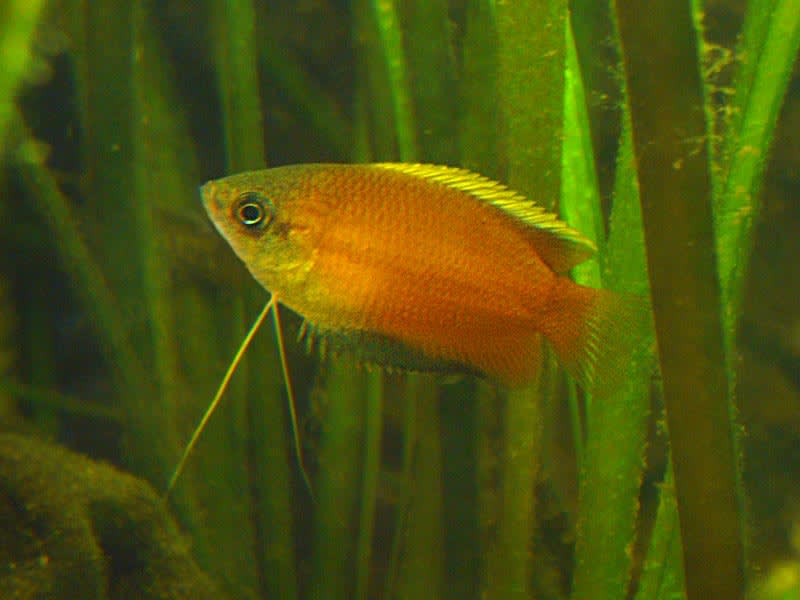
Honey gourami
Trichogaster chuna
Osphronemidae
Easy
Parameter dashboard
Temperature
22-27 °C
pH
6-7.5
Size
5.5 cm
Lifespan
4 years
Min tank54 L
Price$$$
DietInsectivore
TemperamentPeaceful
OriginGanges/Brahmaputra basins, northern India, Bangladesh, Nepal
Shrimp-safeNo
Care guide
The honey gourami comes from the densely vegetated, sluggish waters of the Ganges and Brahmaputra river systems in northern India, Bangladesh and Nepal. Wild-caught specimens are rare in the trade — virtually all are commercially bred. It is a small labyrinth fish, reaching about 5.5 cm, and one of the best choices for a beginner who wants a gourami that stays peaceful and manageable.
In breeding dress, the male transforms into a breathtaking sight: the body and gill plates turn a deep honey-orange while the head and chest become dark blue to black. Females stay brownish with a dark lateral stripe. Selectively bred 'red', 'sunset' and 'golden' strains do not show this dramatic colour change but carry the same undemanding nature.
Honey gouramis need a well-planted tank with floating plants, gentle filtration (an air-driven sponge filter is ideal) and a tight-fitting lid because they must access the humid air layer above the surface for their labyrinth organ to function. A 60 × 30 cm base (54 litres) suits a pair or small group. Keep the water at 22–27 °C and pH 6.0–7.5.
They are primarily insectivorous. In nature they reportedly spit water droplets to knock insects off overhanging leaves. In the aquarium they need small live or frozen foods such as Daphnia, Artemia and bloodworm alongside quality dried products. They are slow-moving and easily outcompeted at feeding time, so tankmates must be chosen carefully — peaceful cyprinids and Pangio loaches work well, while boisterous or aggressive species do not.
The species is a bubblenester that forms temporary pair bonds. The male builds a nest of bubbles without plant material, guards the eggs (which hatch in 24–36 hours) and should be removed once the fry are free-swimming. Fry are tiny and need infusoria or liquid food for the first week.
Source
Figures on this page were read off these pages. Manufacturers and databases do change or retire pages; if a link is dead, tell us with the correction link below.
Tankmate compatibility (sample)
Pairwise screening against other species in the database (prioritizing the same family when data is available).
Review first (2)
Caution or avoid from automated rules — confirm before mixing.
| Species | Assessment | Notes |
|---|---|---|
| Pearl gourami Trichopodus leerii Caution | Caution | Fish 2x+ larger may eat smaller tankmates Open pair in Compare → |
| Three spot gourami Trichogaster trichopterus Caution | Caution | Fish 2x+ larger may eat smaller tankmates Open pair in Compare → |
9 species with compatible assessment in this sampleCollapse to hide the list; use “Open pair in Compare” for the full matrix.
| Species | Assessment | Notes |
|---|---|---|
| Alien betta Betta splendens hybrid Compatible | Compatible | No rule-based conflicts detected for this pair. Open pair in Compare → |
| Chocolate gourami Sphaerichthys osphromenoides Compatible | Compatible | No rule-based conflicts detected for this pair. Open pair in Compare → |
| Crescent betta Betta imbellis Compatible | Compatible | No rule-based conflicts detected for this pair. Open pair in Compare → |
| Dwarf gourami Trichogaster lalius Compatible | Compatible | No rule-based conflicts detected for this pair. Open pair in Compare → |
| Galaxy betta Betta splendens var. Compatible | Compatible | No rule-based conflicts detected for this pair. Open pair in Compare → |
| Pygmy gourami Trichopsis pumila Compatible | Compatible | No rule-based conflicts detected for this pair. Open pair in Compare → |
| Siamese fighting fish Betta splendens Compatible | Compatible | No rule-based conflicts detected for this pair. Open pair in Compare → |
| Snakehead Betta Betta channoides Compatible | Compatible | No rule-based conflicts detected for this pair. Open pair in Compare → |
| White Seam Betta Betta albimarginata Compatible | Compatible | No rule-based conflicts detected for this pair. Open pair in Compare → |
Same rule engine as Compare. Not a substitute for observation, tank size, or acclimation.
Related species
Keep this species? Spot anything off?