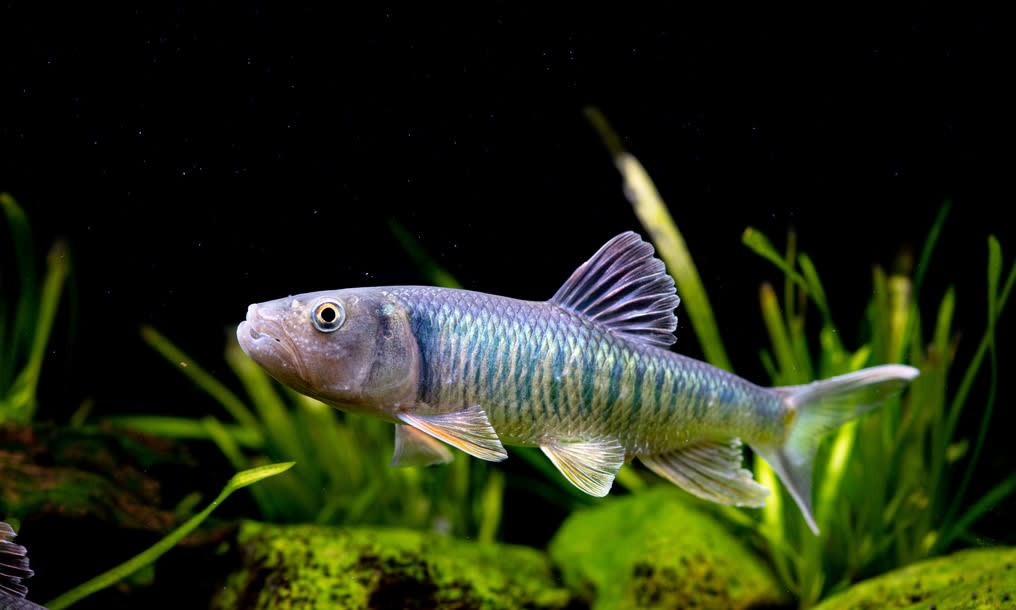
Horsehead
Opsariichthys bidens
Parameter dashboard
10-20 °C
6.5-7
21 cm
8 years
Care guide
The horse-mouth fish is named for its distinctive jaw: the upper jaw has a central notch and the lower jaw a matching knob, giving the mouth a hooked profile. Known scientifically as Opsariichthys bidens, this cyprinid comes from the clear, well-oxygenated upper reaches of rivers across China, Taiwan, Laos and Vietnam. Adults reach about 21 cm standard length.
This is a temperate species. Unlike most aquarium fish it prefers cool water in the 10–20 °C range and does not need a heater — in fact, sustained tropical temperatures will shorten its lifespan. A tank of at least 150 litres with strong filtration and current suits a small group. A tight-fitting lid is essential because horse-mouth fish are accomplished jumpers.
In nature they feed on aquatic insects, small fish and zooplankton. In the aquarium they accept quality pellets and flakes but benefit greatly from live and frozen foods such as bloodworm, brine shrimp and chopped earthworms. Their carnivorous tendencies mean they may eat very small tankmates, and they are not safe with dwarf shrimp.
Male horse-mouth fish develop vertical dark bars and extended anal fin rays during the breeding season. They are loosely social and should be kept in a group of five or more. The IUCN lists this species as Least Concern as of 2020.
Source
Figures on this page were read off these pages. Manufacturers and databases do change or retire pages; if a link is dead, tell us with the correction link below.
Tankmate compatibility (sample)
Pairwise screening against other species in the database (prioritizing the same family when data is available).
Review first (12)
Caution or avoid from automated rules — confirm before mixing.
| Species | Assessment | Notes |
|---|---|---|
| Blue gularis Fundulopanchax sjostedti Avoid | Avoid | Species with non-overlapping temperature ranges cannot coexist · the two share only a narrow band of temperature, so one of them sits at the edge of its range Open pair in Compare → |
| Chocolate gourami Sphaerichthys osphromenoides Avoid | Avoid | Fish 2x+ larger may eat smaller tankmates · Species with non-overlapping temperature ranges cannot coexist · Species with non-overlapping pH ranges may not thrive together · the two share only a narrow band of temperature, so one of them sits at the edge of its range Open pair in Compare → |
| Coolie loach Pangio semicincta Avoid | Avoid | Fish 2x+ larger may eat smaller tankmates · Species with non-overlapping temperature ranges cannot coexist · Species with non-overlapping pH ranges may not thrive together · the two share only a narrow band of temperature, so one of them sits at the edge of its range Open pair in Compare → |
| Dwarf rasbora Boraras maculatus Avoid | Avoid | Fish 2x+ larger may eat smaller tankmates · Species with non-overlapping temperature ranges cannot coexist · Species with non-overlapping pH ranges may not thrive together · the two share only a narrow band of temperature, so one of them sits at the edge of its range Open pair in Compare → |
| Gold Nugget Pleco Baryancistrus xanthellus Avoid | Avoid | Species with non-overlapping temperature ranges cannot coexist · the two share only a narrow band of temperature, so one of them sits at the edge of its range Open pair in Compare → |
| Molly Poecilia sphenops Avoid | Avoid | Fish 2x+ larger may eat smaller tankmates · Species with non-overlapping temperature ranges cannot coexist · Species with non-overlapping pH ranges may not thrive together · the two share only a narrow band of temperature, so one of them sits at the edge of its range Open pair in Compare → |
| Pearl gourami Trichopodus leerii Avoid | Avoid | Species with non-overlapping temperature ranges cannot coexist · the two share only a narrow band of temperature, so one of them sits at the edge of its range Open pair in Compare → |
| Rainbow krib Pelvicachromis pulcher Avoid | Avoid | Fish 2x+ larger may eat smaller tankmates · Species with non-overlapping temperature ranges cannot coexist · the two share only a narrow band of temperature, so one of them sits at the edge of its range Open pair in Compare → |
| Snakehead Betta Betta channoides Avoid | Avoid | Fish 2x+ larger may eat smaller tankmates · Species with non-overlapping temperature ranges cannot coexist · Species with non-overlapping pH ranges may not thrive together · the two share only a narrow band of temperature, so one of them sits at the edge of its range Open pair in Compare → |
| Sumatra barb Puntigrus tetrazona Avoid | Avoid | Fish 2x+ larger may eat smaller tankmates · Species with non-overlapping temperature ranges cannot coexist · the two share only a narrow band of temperature, so one of them sits at the edge of its range Open pair in Compare → |
| Whiptail catfish Farlowella acus Avoid | Avoid | Species with non-overlapping temperature ranges cannot coexist · the two share only a narrow band of temperature, so one of them sits at the edge of its range Open pair in Compare → |
| Zebra Oto Otocinclus cocama Avoid | Avoid | Fish 2x+ larger may eat smaller tankmates · Species with non-overlapping temperature ranges cannot coexist · the two share only a narrow band of temperature, so one of them sits at the edge of its range Open pair in Compare → |
Same rule engine as Compare. Not a substitute for observation, tank size, or acclimation.
Was this page useful? Spot anything wrong?