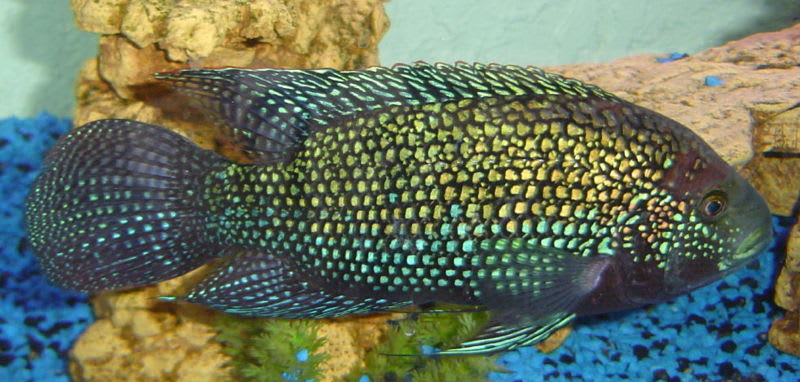
Jack Dempsey
Rocio octofasciata
Cichlidae
Moderate
Parameter dashboard
Temperature
20-30 °C
pH
6.5-8
Size
20 cm
Lifespan
10 years
Min tank243 L
Price$$$$
DietOmnivore
TemperamentAggressive
OriginCentral America
Shrimp-safeNo
Care guide
The Jack Dempsey cichlid reaches about 20 cm standard length and carries the name of the American heavyweight boxer, reportedly for its strong facial features and pugnacious nature. It comes from the Atlantic slope of Central America, from the Río Actopan in Veracruz, Mexico south through Belize and Guatemala to the rivers of western Honduras, and it is an ecological generalist there: coastal drainages, slow lower river reaches, man-made canals, drainage ditches, lakes and ponds all hold it. Aquarium releases have since founded feral populations as far apart as the United States, Russia, Australia and Thailand.
An adult pair needs a base of at least 120 by 45 cm, roughly 243 litres. Young fish can be grown on together but turn territorial as they mature, and a bonded pair will be peaceful with each other while staying hostile to other cichlids and to anything of similar shape. A community is possible if every tankmate is too large to read as prey, though housing this species with other cichlids takes a much bigger tank. Water quality matters more than decor: these fish are sensitive to deteriorating conditions and should never go into a biologically immature aquarium.
Keep the water at 20 to 30 °C, pH 6.5 to 8.0 and 5 to 20 dGH. Use soft sand with a flat water-worn rock or two as potential spawning sites, dim lighting, and driftwood or roots for structure. Rooted plants get dug up, so attach java fern or anubias to the decor instead. Feed a varied diet of sinking dried food, frozen daphnia, mosquito and chironomid larvae and prawn. Spawning is biparental on a substrate, so a settled pair will guard eggs and fry together. An electric blue strain sold as EBJD turns up occasionally and tends to stay smaller.
Sources
- seriouslyfish.com — https://www.seriouslyfish.com/species/rocio-octofasciata/
- fishbase.se — https://www.fishbase.se/summary/Rocio-octofasciata.html
Figures on this page were read off these pages. Manufacturers and databases do change or retire pages; if a link is dead, tell us with the correction link below.
Tankmate compatibility (sample)
Pairwise screening against other species in the database (prioritizing the same family when data is available).
Review first (8)
Caution or avoid from automated rules — confirm before mixing.
| Species | Assessment | Notes |
|---|---|---|
| Bluegray mbuna Melanochromis johannii Caution | Caution | Fish 2x+ larger may eat smaller tankmates · Multiple territorial species in the same swim layer cause stress Open pair in Compare → |
| Chessboard cichlid Dicrossus filamentosus Caution | Caution | Multiple territorial species in the same swim layer cause stress Open pair in Compare → |
| Demon eartheater Satanoperca jurupari Caution | Caution | Multiple territorial species in the same swim layer cause stress Open pair in Compare → |
| Fasciatus Shell Dweller Altolamprologus fasciatus Caution | Caution | Species with non-overlapping pH ranges may not thrive together Open pair in Compare → |
| Gold Cap Caudopunctatus Neolamprologus caudopunctatus Caution | Caution | Fish 2x+ larger may eat smaller tankmates · Multiple territorial species in the same swim layer cause stress Open pair in Compare → |
| Gold Shell Dweller Lamprologus ocellatus Caution | Caution | Fish 2x+ larger may eat smaller tankmates Open pair in Compare → |
| Humphead cichlid Cyphotilapia frontosa Caution | Caution | Species with non-overlapping pH ranges may not thrive together Open pair in Compare → |
| Umbrella cichlid Apistogramma borellii Caution | Caution | Fish 2x+ larger may eat smaller tankmates Open pair in Compare → |
4 species with compatible assessment in this sampleCollapse to hide the list; use “Open pair in Compare” for the full matrix.
| Species | Assessment | Notes |
|---|---|---|
| Blue acara Andinoacara pulcher var. Compatible | Compatible | No rule-based conflicts detected for this pair. Open pair in Compare → |
| Freshwater angelfish Pterophyllum scalare Compatible | Compatible | No rule-based conflicts detected for this pair. Open pair in Compare → |
| Livingstonii Cichlid Nimbochromis livingstonii Compatible | Compatible | No rule-based conflicts detected for this pair. Open pair in Compare → |
| Moga Hypsophrys nicaraguensis Compatible | Compatible | No rule-based conflicts detected for this pair. Open pair in Compare → |
Same rule engine as Compare. Not a substitute for observation, tank size, or acclimation.
Related species
Keep this species? Spot anything off?