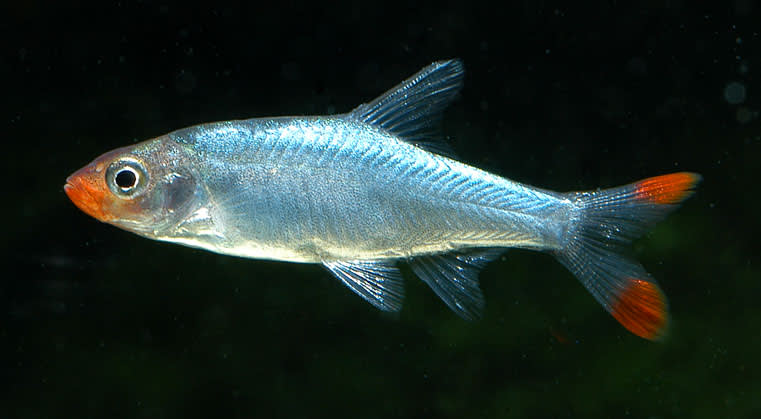
Sawbwa barb
Sawbwa resplendens
Cyprinidae
Moderate
Parameter dashboard
Temperature
18-22 °C
pH
6-8
Size
3 cm
Lifespan
3 years
Min tank54 L
Price$$
DietOmnivore
TemperamentPeaceful
OriginMyanmar (Lake Inlé)
Shrimp-safeYes
Care guide
The Sawbwa barb (Sawbwa resplendens), also known as the Asian rummy-nose or Asian rummy-nose rasbora, is a small cyprinid endemic to Lake Inlé and its associated watershed in Shan State, eastern Myanmar. It reaches only 25-35 mm (1.0-1.4 in) in length and exhibits a striking colour pattern: males display a bright red snout and caudal fin with a silvery body and a characteristic black spot at the base of the tail, while females are plainer. The species is listed as Endangered on the IUCN Red List due to sedimentation, eutrophication, and introduced predatory fish species in its shrinking natural habitat.
This species requires cool, well-oxygenated water and is best suited to a heavily planted aquarium of at least 54 L (14 gal) with a dark substrate, dense vegetation, and floating plants to create broken lines of sight. Water flow should be gentle. The recommended temperature range of 18-22°C (64-72°F) means a heater is often unnecessary in most indoor environments. pH should be maintained at 6.0-8.0 with moderate hardness of 54-268 ppm. Despite their peaceful disposition toward other species, males engage in continual dominance battles, so a female-to-male ratio of at least 4:1 is strongly recommended.
Sawbwa barbs are shoaling rather than true schooling fish and should be kept in groups of at least six. They thrive on a diet of small live and frozen foods such as Daphnia, Artemia, and microworm, though they will accept high-quality dried foods of suitable size. Their small size and peaceful nature toward non-conspecifics make them suitable for nano tanks with other small, cool-water species, but they should not be housed with larger or more boisterous fish. Breeding in captivity is possible but infrequently reported.
Sources
- seriouslyfish.com — https://www.seriouslyfish.com/species/sawbwa-resplendens/
- en.wikipedia.org — https://en.wikipedia.org/wiki/Sawbwa_resplendens
Figures on this page were read off these pages. Manufacturers and databases do change or retire pages; if a link is dead, tell us with the correction link below.
Tankmate compatibility (sample)
Pairwise screening against other species in the database (prioritizing the same family when data is available).
Review first (9)
Caution or avoid from automated rules — confirm before mixing.
| Species | Assessment | Notes |
|---|---|---|
| Chinese barb Barbodes semifasciolatus Caution | Caution | Fish 2x+ larger may eat smaller tankmates Open pair in Compare → |
| Reticulated Sae Crossocheilus reticulatus Caution | Caution | Fish 2x+ larger may eat smaller tankmates Open pair in Compare → |
| Rosy barb Pethia conchonius Caution | Caution | Fish 2x+ larger may eat smaller tankmates Open pair in Compare → |
| Clown rasbora Rasbora kalochroma Avoid | Avoid | Fish 2x+ larger may eat smaller tankmates · Species with non-overlapping temperature ranges cannot coexist Open pair in Compare → |
| Least rasbora Boraras urophthalmoides Avoid | Avoid | Species with non-overlapping temperature ranges cannot coexist Open pair in Compare → |
| Panda Garra Garra flavatra Avoid | Avoid | Fish 2x+ larger may eat smaller tankmates · Species with non-overlapping temperature ranges cannot coexist Open pair in Compare → |
| Siamese flying fox Crossocheilus oblongus Avoid | Avoid | Fish 2x+ larger may eat smaller tankmates · Species with non-overlapping temperature ranges cannot coexist Open pair in Compare → |
| Three-lined rasbora Rasbora trilineata Avoid | Avoid | Fish 2x+ larger may eat smaller tankmates · Species with non-overlapping temperature ranges cannot coexist Open pair in Compare → |
| Tinfoil barb Barbonymus schwanenfeldii Avoid | Avoid | Fish 2x+ larger may eat smaller tankmates · Species with non-overlapping temperature ranges cannot coexist Open pair in Compare → |
3 species with compatible assessment in this sampleCollapse to hide the list; use “Open pair in Compare” for the full matrix.
| Species | Assessment | Notes |
|---|---|---|
| Cherry barb Puntius titteya Compatible | Compatible | No rule-based conflicts detected for this pair. Open pair in Compare → |
| Chili Rasbora Boraras brigittae Compatible | Compatible | No rule-based conflicts detected for this pair. Open pair in Compare → |
| Dwarf rasbora Boraras maculatus Compatible | Compatible | No rule-based conflicts detected for this pair. Open pair in Compare → |
Same rule engine as Compare. Not a substitute for observation, tank size, or acclimation.
Related species
Keep this species? Spot anything off?