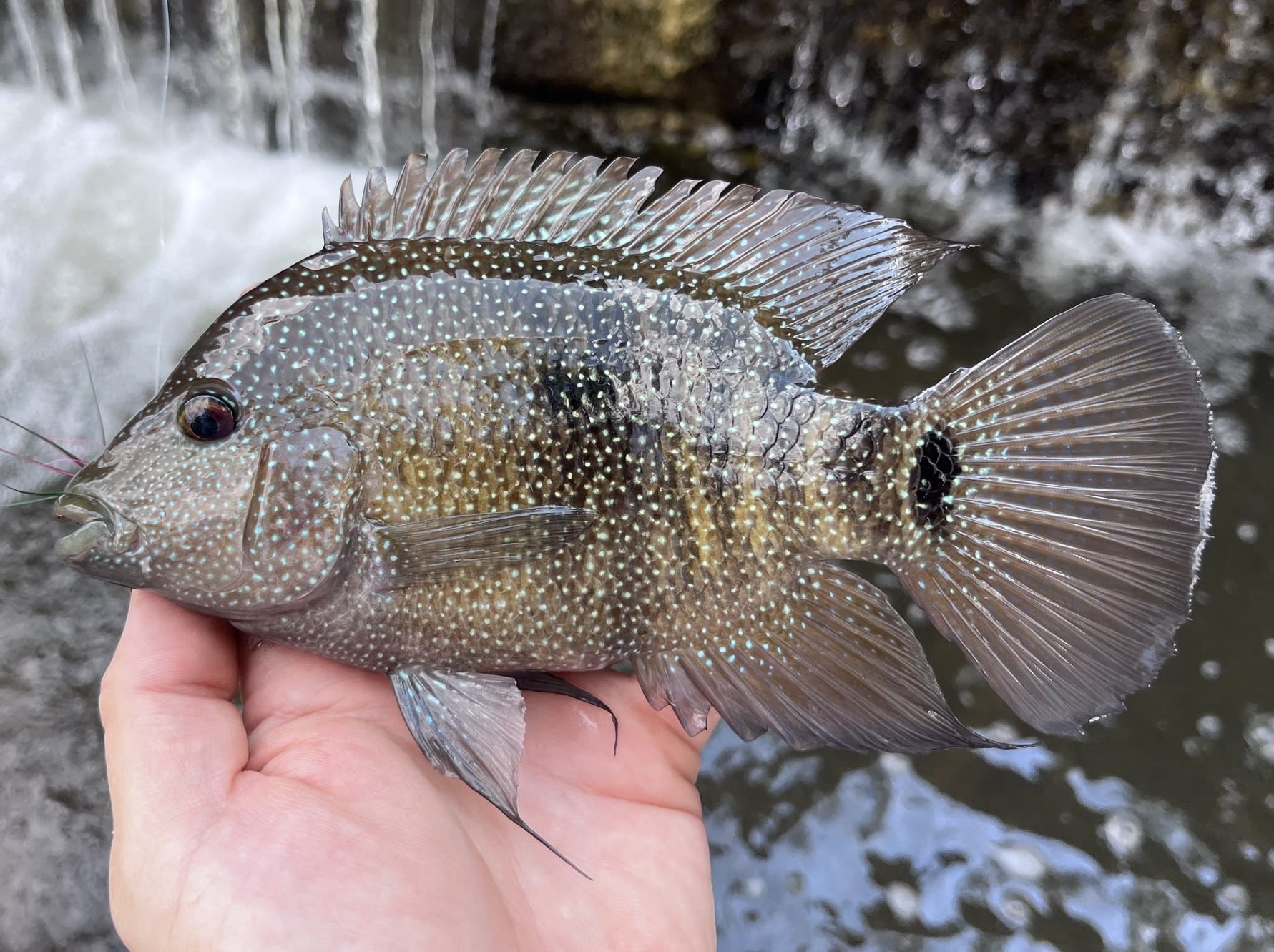
Rio Grande cichlid
Herichthys cyanoguttatus
Cichlidae
Moderate
Parameter dashboard
Temperature
20-26 °C
pH
6-7.5
Size
24 cm
Lifespan
12 years
Min tank255 L
Price$$$$
DietOmnivore
TemperamentAggressive
OriginNorth America
Shrimp-safeNo
Care guide
The Rio Grande cichlid holds a unique distinction among North American freshwater fish: it is the only cichlid species native to the United States, occurring naturally in the Rio Grande drainage of Texas and Mexico, with introduced populations now established in Florida and elsewhere. Males can reach about 24 cm standard length (30 cm total length) and develop a pronounced nuchal hump with age, along with pointed extensions to the dorsal and anal fins. The body is covered in small, iridescent cream-coloured spots on a grey-green background , a pattern dense enough that from a distance the fish appears silvery. A single specimen needs a tank of at least 255 litres (a 120×45×45 cm footprint ), andand anything smaller risks stunting and amplifying aggression. These are powerful diggers that will rearrange substrate to their liking, so a deep sand bed with smooth rocks and driftwood works better than an elaborate aquascape. Temperature in the aquarium should be maintained at 20–26°C, staying near the cooler end of the wide 20–33°C range the species tolerates in nature, which promotes a longer lifespan. pH of 6.0–7.5 with moderate hardness suits them well. The diet is unfussy — take a quality cichlid pellet as the staple and supplement with live and frozen foods plus some vegetable matter. Temperament is the main consideration: Rio Grande cichlids are highly territorial and aggressive, especially males in tanks under 180 cm in length. They are best kept alone or as a bonded pair in a very large tank; tankmates must be robust enough to handle the constant harassment. Breeding pairs form naturally when a group of juveniles is raised together, and the parents are excellent caregivers to their fry.
Sources
- seriouslyfish.com — https://seriouslyfish.com/species/herichthys-cyanoguttatus
- fishbase.se — https://www.fishbase.se/summary/Herichthys-cyanoguttatus.html
Figures on this page were read off these pages. Manufacturers and databases do change or retire pages; if a link is dead, tell us with the correction link below.
Tankmate compatibility (sample)
Pairwise screening against other species in the database (prioritizing the same family when data is available).
Review first (12)
Caution or avoid from automated rules — confirm before mixing.
| Species | Assessment | Notes |
|---|---|---|
| Blue streak hap Labidochromis caeruleus Caution | Caution | Fish 2x+ larger may eat smaller tankmates · Multiple territorial species in the same swim layer cause stress · Species with non-overlapping pH ranges may not thrive together Open pair in Compare → |
| Fasciatus Shell Dweller Altolamprologus fasciatus Caution | Caution | Multiple territorial species in the same swim layer cause stress · Species with non-overlapping pH ranges may not thrive together Open pair in Compare → |
| Gold Shell Dweller Lamprologus ocellatus Caution | Caution | Fish 2x+ larger may eat smaller tankmates · Multiple territorial species in the same swim layer cause stress · Species with non-overlapping pH ranges may not thrive together Open pair in Compare → |
| Greenstreaked eartheater Biotodoma cupido Caution | Caution | Fish 2x+ larger may eat smaller tankmates · Multiple territorial species in the same swim layer cause stress Open pair in Compare → |
| Humphead cichlid Cyphotilapia frontosa Caution | Caution | Multiple territorial species in the same swim layer cause stress · Species with non-overlapping pH ranges may not thrive together Open pair in Compare → |
| Leleupi Cichlid Neolamprologus leleupi Caution | Caution | Fish 2x+ larger may eat smaller tankmates · Multiple territorial species in the same swim layer cause stress · Species with non-overlapping pH ranges may not thrive together Open pair in Compare → |
| Livingstonii Cichlid Nimbochromis livingstonii Caution | Caution | Multiple territorial species in the same swim layer cause stress · Species with non-overlapping pH ranges may not thrive together Open pair in Compare → |
| Mendezs Dwarf Cichlid Apistogramma mendezi Caution | Caution | Fish 2x+ larger may eat smaller tankmates · Species with non-overlapping pH ranges may not thrive together Open pair in Compare → |
| Multies Neolamprologus multifasciatus Caution | Caution | Fish 2x+ larger may eat smaller tankmates · Multiple territorial species in the same swim layer cause stress · Species with non-overlapping pH ranges may not thrive together Open pair in Compare → |
| Princess of Burundi Neolamprologus brichardi Caution | Caution | Fish 2x+ larger may eat smaller tankmates · Multiple territorial species in the same swim layer cause stress · Species with non-overlapping pH ranges may not thrive together Open pair in Compare → |
| Redhump eartheater Geophagus steindachneri Caution | Caution | Multiple territorial species in the same swim layer cause stress Open pair in Compare → |
| Ram cichlid Mikrogeophagus ramirezi Avoid | Avoid | Fish 2x+ larger may eat smaller tankmates · Multiple territorial species in the same swim layer cause stress · Species with non-overlapping temperature ranges cannot coexist Open pair in Compare → |
Same rule engine as Compare. Not a substitute for observation, tank size, or acclimation.
Related species
Keep this species? Spot anything off?