Aquascaping: rule of thirds (and what it borrows from landscape painting)
The rule of thirds did not start in aquariums. It comes from 18th-century landscape painting theory — John Thomas Smith's Remarks on Rural Scenery (1797) introduced the principle as a way to avoid the "false harmony" of central placement. Photographers adopted it in the late 19th century, then cinematographers, and eventually aquascapers. The rule is not magic; it is a heuristic that aligns layout with how human vision actually scans a frame.
Why thirds, not halves
Eye-tracking studies on visual art (Locher, Empirical Studies of the Arts, 1996; Privitera & Stark, IEEE Trans Pattern Anal Mach Intell, 2000) consistently show that viewers fixate on off-center points of interest within the first 200 ms of viewing. When a single focal element sits in the dead center, the eye locks there and stops exploring. When it sits one-third of the way from a frame edge, the eye drifts across the rest of the composition seeking secondary objects.
This is not aesthetic preference; it is a measurable consequence of how the visual cortex builds a scene representation. Composition theorists call it "saccadic pull." Apply it to a 60 cm tank: place your main piece of driftwood at 20 cm from the left edge (not 30 cm at center), and the viewer's eye will travel right toward the planted background instead of stopping.
The 3×3 grid in practice
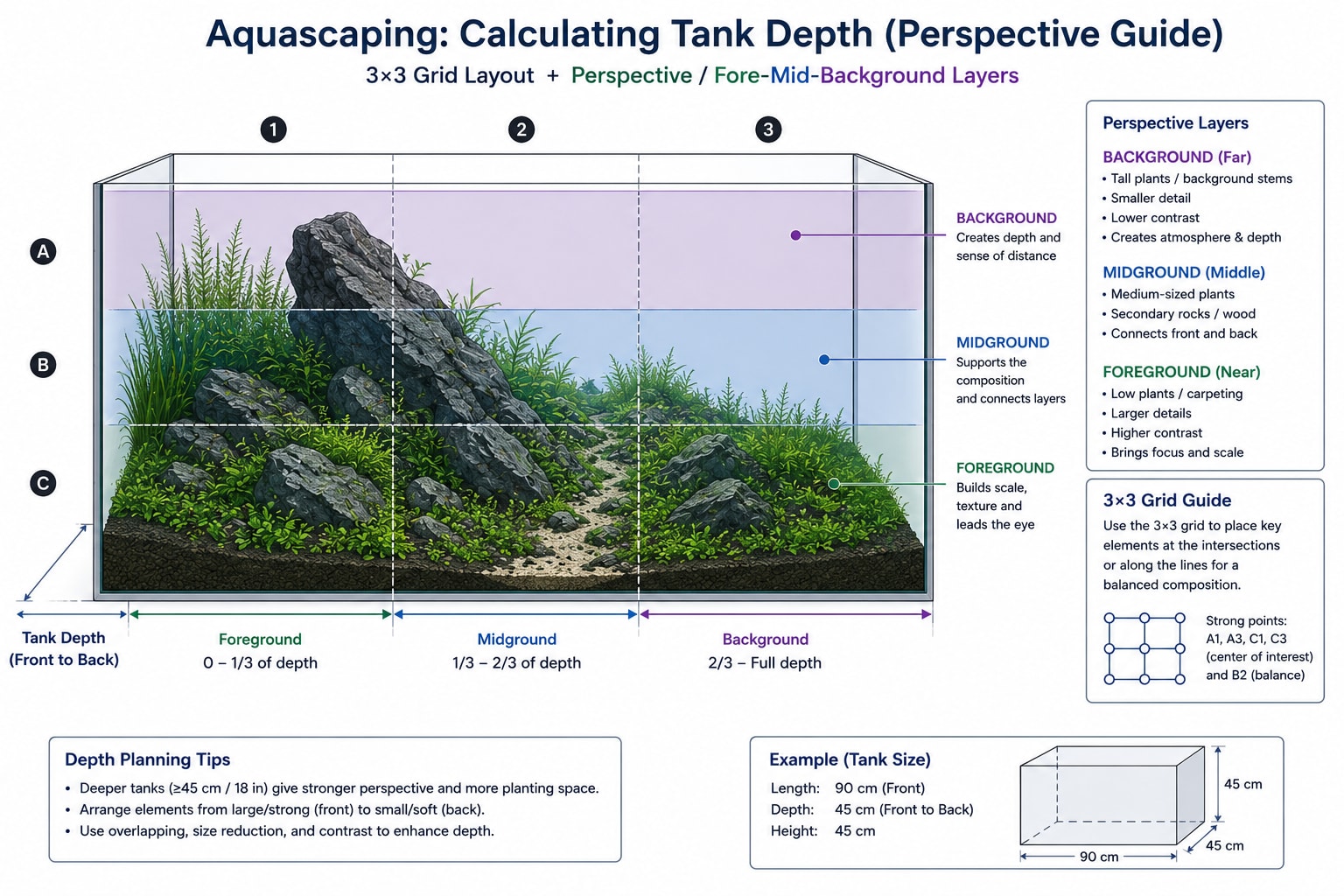
Divide the front glass mentally into a 3×3 grid. The four intersections are visual anchor points. The two horizontal lines suggest where to place horizons (the substrate slope, the canopy of the tallest plants). The two vertical lines suggest where to place strong vertical elements (the tallest stones, the trunk of a hardscape "tree").
A common entry-level mistake is placing a single rock dead center and surrounding it with symmetric planting. The result reads as static: the viewer's eye stops, and the rest of the layout becomes background. Move that same rock one grid unit to the left, plant Cryptocoryne densely on the right third, and the same components produce depth — because now the eye has somewhere to go.
Depth without a bigger tank
A common goal in aquascaping is to create the perception of more depth than the physical front-to-back dimension allows. Three techniques compound:
Foreground / midground / background separation — short foreground plants or sand paths near the front glass, hardscape that breaks the horizon line in the middle distance, taller stems behind. The brain interprets the size gradient as depth.
Atmospheric perspective — slightly hazier or less saturated background plants (achieved by darker substrate, less aggressive lighting on the rear, or by planting smaller-leaved species in back). Distant objects in nature have lower contrast due to atmospheric scatter; mimicking that low contrast in the back of the tank simulates distance.
Slope toward the back — substrate raised 2–4× higher at the back wall than the front glass. The slope itself is a depth cue (the eye reads "rising terrain = distant"), and it gives background plants the height they need to break the canopy line.
Negative space is not wasted space
Open sand, an empty water column, a path of bare substrate between two planting groups — these are not "missing" plants. They are part of the composition. In painting they would be called "rest areas" or "negative space." In photography, they're the sky above a mountain.
Densely planted "every-square-centimeter-covered" tanks have a name in the aquascaping community: noise tanks. They look impressive at the moment of planting and chaotic after one month of growth. Takashi Amano founded the modern planted aquascape genre and worked from the 1980s to the 2010s. He built his career on leaving roughly one-third of the layout as negative space. His diorama-style tanks often have a single dramatic sand path or a wide swath of low carpet with nothing else.
Hardscape first, plants second
Plants can be moved with little cost during the first month. Stones and driftwood, once planted around and anchored by Anubias rhizomes and moss growth, are immovable without dismantling the layout.
Build hardscape on dry foam before adding substrate. Use newsprint or pencil to sketch the side view and front view first — even a rough sketch forces you to commit to a hardscape intention before stones go in. Aquascapers who skip this step typically rebuild within three months when they realize the proportions look wrong.
Light direction shapes the scene
Photoperiod and fixture position interact with hardscape height. A tall background piece will shadow the foreground if the light is centered; the same piece will not shadow if light is positioned over the front. Use the shadow:
- Hide intake pipes behind tall stems or rocks if you want a clean front view.
- Reduce algae on slow-growing rhizome plants by positioning them in partial shadow.
- Highlight a focal rock or driftwood by aiming the brightest part of the fixture at its leading edge.
Modern LED fixtures such as the Twinstar S-line have asymmetric beam profiles. Read the manufacturer's PAR map before committing to fixture placement.
A practical checklist before you plant
- Sketch the layout on paper or in a digital tool. Even three thumbnail sketches reveal which framing has stronger asymmetry.
- Place hardscape dry, photograph the front view, and live with the photo for 24 hours before adding substrate. You'll spot weak compositions overnight.
- Bury a foam riser behind the back wall to elevate substrate without filling 30% of the tank volume with inert mass.
- Browse the plant catalog sorted by max height for the background layer. Use My Tank to verify your light intensity matches the most demanding species.
The rule of thirds is one heuristic among many — golden ratio, leading lines, color triadic harmony, the Iwagumi seven-stone principle. None are absolute. They are starting frames that let you commit to a composition fast, then break the rule deliberately once you understand what each rule is preventing.
References
- Smith, J. T. (1797). Remarks on Rural Scenery. London.
- Locher, P. J. (1996). The contribution of eye-movement research to an understanding of the nature of pictorial balance perception. Empirical Studies of the Arts, 14(2), 143–163.
- Privitera, C. M., & Stark, L. W. (2000). Algorithms for defining visual regions-of-interest. IEEE Transactions on Pattern Analysis and Machine Intelligence, 22(9), 970–982.
- Amano, T. (1994). Nature Aquarium World Book One. T.F.H. Publications.
- Arnheim, R. (1974). Art and Visual Perception: A Psychology of the Creative Eye. University of California Press.