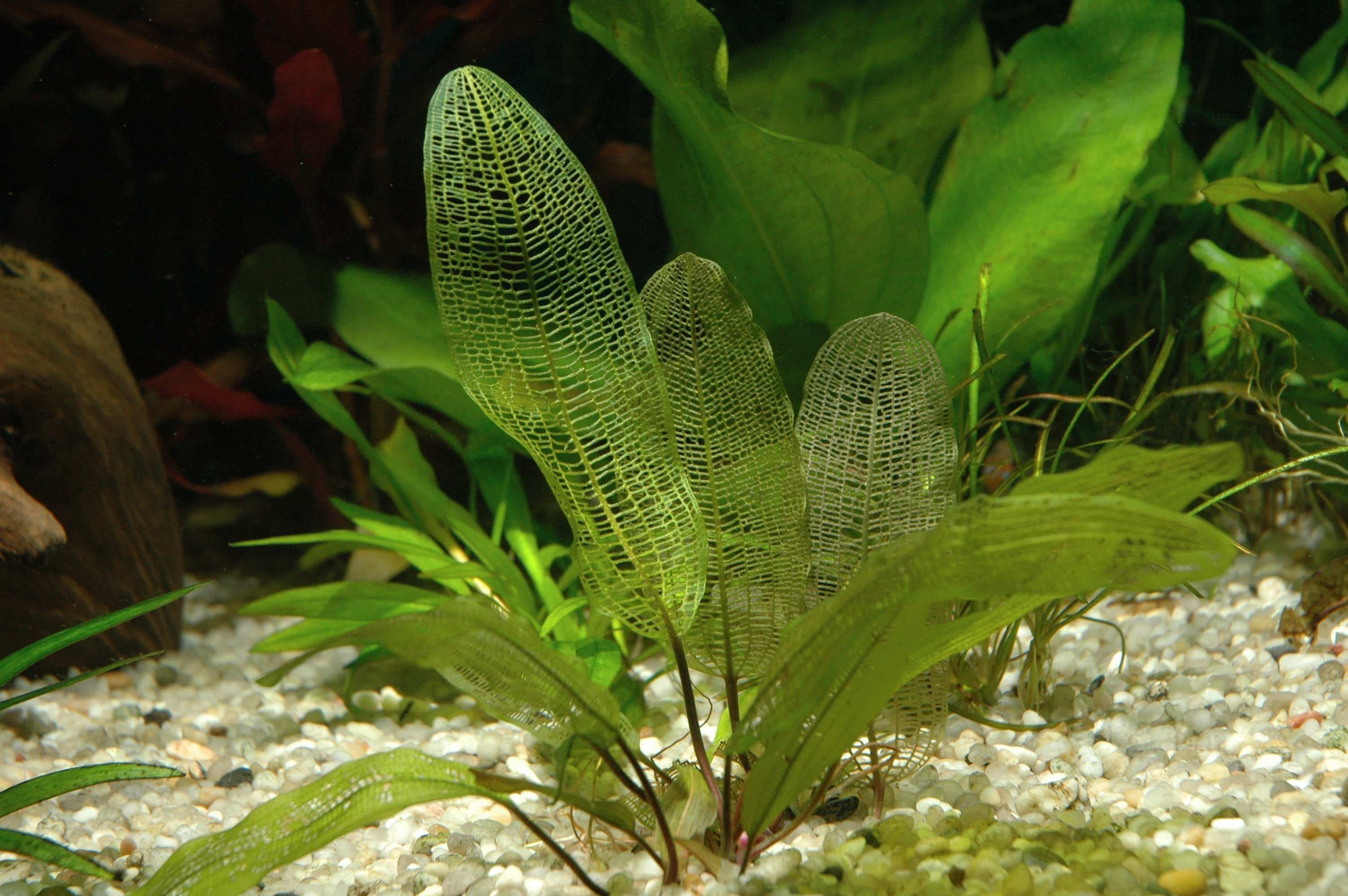
Lace Plant
Aponogeton madagascariensis
Survival dashboard
Medium
Required
17–27 °C
4.5–6.5
Aquascaping
Trim schedule (hint)
Fast growers usually need trimming every 1–2 weeks once established.
Description
Aponogeton madagascariensis, the Madagascar lace plant, has a lacy leaf structure unlike any other plant's, and it has been a challenge for hobbyists since the 1950s. It grows in flowing water on Madagascar. It is recommended only as a solitary plant in large, specialised aquariums where the water is changed often.
Several varieties exist. The broad-leaved var. henkelianus and var. major have white or yellowish flowers, while var. madagascariensis, which is readily available in the trade, grows much larger and has pink to purple flowers. Plants reach 25 to 50 cm, and a fully grown specimen is too large for any tank under 500 litres.
The optimum is 17 to 27 °C and pH 4.5 to 6.5, and the plant is noticeably more vigorous below 24 °C, since warmer water slows growth and shrinks the leaves. Give it medium light that falls directly on the plant. It needs CO₂ and a steady supply of micro and macronutrients, and it is especially prone to iron deficiency. Short of CO₂ and nutrients it keeps making leaves by drawing on the tuber's reserves, and dies once those are used up.
The two sources disagree about the substrate. The species prefers a lean one, and dark brown patches spreading across older leaves mean it is too rich, though fertiliser capsules help growth considerably. Both say the growing tip must stay above the substrate. Established roots of small, compact Cryptocorynes help the bulb anchor, as long as they never outgrow or shade it. Some literature describes a rest phase in which every leaf dies back, but a well-kept plant can go on growing for years without one. If it does rest, never let the tuber dry out.
Source
Figures on this page were read off these pages. Manufacturers and databases do change or retire pages; if a link is dead, tell us with the correction link below.
Was this page useful? Spot anything wrong?