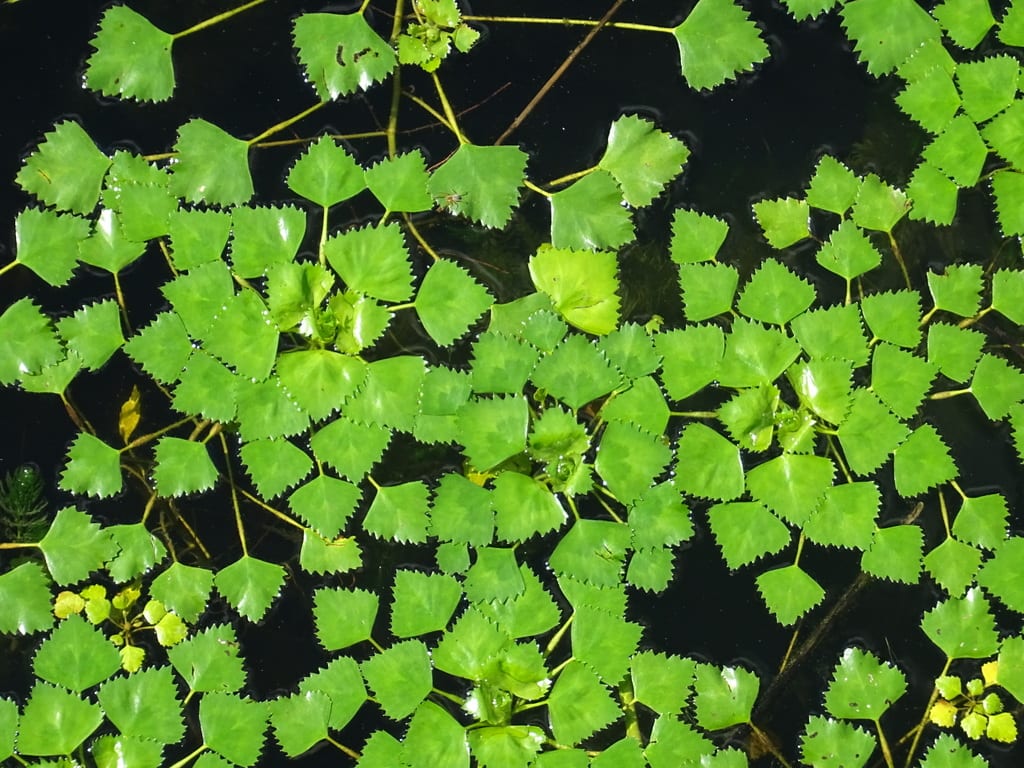
water chestnut
Trapa natans
Survival dashboard
High
Not required
20–28 °C
6–8
Aquascaping
Trim schedule (hint)
Expect trimming about every 2–4 weeks depending on light and nutrients.
Description
Check what your local rules say before buying this one. Water chestnut was introduced to the United States in the 1870s as an ornamental and is now tracked as an aquatic invasive there, forming mats dense enough to crowd out native plants and obstruct boat traffic, so it is restricted in a number of places. Nothing about it should ever reach a pond, ditch or waterway.
Kept deliberately, it is an annual with two entirely different sets of leaves. Above the surface it forms rosettes of stiff, diamond-shaped leaves whose stalks are swollen with air pockets that hold the plant up. Below it, the submersed leaves are finely divided and feathery, so the plant looks like two species depending on which side of the waterline you view it from.
It is native across Europe, Asia and Africa, and belongs to the loosestrife family rather than to the unrelated Chinese water chestnut sold as a vegetable. Its own seeds are the large horned nuts that have been eaten across Eurasia since prehistory.
Strong light is needed for the rosettes to develop properly; in dim conditions the floating leaves stay small. It grows at 20 to 28 °C and pH 6 to 8, needs no CO2, and can shade out everything beneath it, so surface cover has to be managed. Being annual, it completes its cycle and sets seed, which needs a cool rest before it will germinate.
Keep this species? Spot anything off?