Intermediate
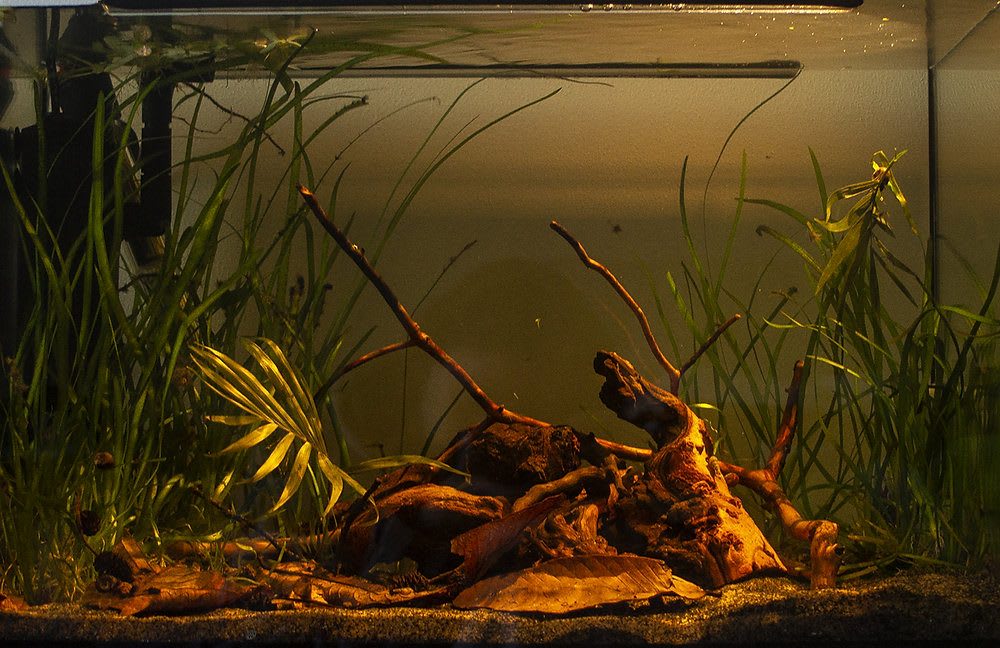
Amazon Blackwater
Leaf tannins, driftwood architecture, and dim light for forest-floor species.
Volume
120 L
Est. monthly cost
~$28
Water target
25–28 °C · pH 5.8–6.8
Overview
Recreate soft, acidic conditions with botanicals, gentle circulation, and species that prefer subdued light and shy territories.
Use driftwood as the primary hardscape; sand or fine gravel substrate. Botanicals release tannins—remove debris weekly to avoid ammonia spikes from decomposition.
Filtration should polish water without blasting surface dwellers. A canister with spray bar or lily pipes keeps flow soft at mid-column.
Plant palette: cryptocorynes, narrow-leaf swords, and floating plants to diffuse light. CO2 is optional; many setups run low-tech with liquid carbon only if needed.
Step-by-step setup guide
Tank & substrate
Day 1Set up the 120 L tank on a stable stand. Use fine natural sand (pool filter sand or ADA La Plata sand) as the primary substrate, 3–5 cm deep. Sand is authentic to Amazonian river floors and allows corydoras to sift naturally. No nutrient-rich soil needed—this build relies on water-column feeding and root tabs for individual plants.
- ▸Rinse sand thoroughly until water runs clear to avoid days of cloudiness.
- ▸Slope sand slightly toward the back for a natural riverbed look.
Driftwood architecture
Day 1–2Driftwood is the centerpiece. Choose 2–3 pieces of Malaysian, Mopani, or Spider wood to create an interlocking structure suggesting fallen branches. Position the largest piece off-center and angle secondary pieces to create caves and overhangs. These become territories for angelfish and hiding spots for shy tetras. Pre-soak wood for 1–2 weeks or boil for several hours to reduce tannin surge.
- ▸Let some wood break the waterline for an emergent, natural feel.
- ▸Attach wood to a stone base with aquarium-safe epoxy if it floats.
- ▸Leave open swimming lanes between wood pieces for schooling tetras.
Botanical layer
Day 2Scatter Indian almond (catappa) leaves, dried banana leaves, and seed pods across the substrate. These slowly release tannins that tint the water amber, lower pH, and provide natural antibacterial and antifungal properties. Start with 4–6 large catappa leaves and 10–15 alder cones. They also become grazing surfaces for biofilm, which corydoras and shrimp will appreciate.
- ▸Replace decomposed leaves monthly—they break down fully in 3–4 weeks.
- ▸Too many botanicals at once can crash pH; add gradually and monitor.
Planting
Day 2–3Plant Cryptocoryne wendtii and C. lucens in mid-ground clusters around driftwood bases—they tolerate low light and soft water. Attach Java fern to driftwood using super glue gel (never bury the rhizome). Place Amazon sword (Echinodorus) as a background focal plant with a root tab beneath it. Add floating plants (Amazon frogbit or Salvinia) to dim the light naturally and complete the canopy effect.
- ▸Crypts often 'melt' after planting; leave them alone—new leaves adapted to your water will grow from the roots.
- ▸Floating plants multiply fast; thin weekly to prevent blocking all light.
Equipment setup
Day 3Install a canister filter with spray bar pointed along the back glass for gentle, even flow—blackwater fish dislike strong current. Use a 150 W adjustable heater set to 26 °C. Lighting should be moderate to low: 20–30 PAR at substrate, 7–8 hours daily. No CO2 injection—this is a low-tech build. Add a thermometer on the opposite end from the heater to verify consistent temperature.
- ▸A spray bar angled slightly upward creates surface agitation for gas exchange without blasting mid-water fish.
- ▸Run filter media in order: coarse sponge → bio rings → fine floss. Skip activated carbon if you want to preserve tannin color.
Water conditioning & cycling
Week 1–3Fill with dechlorinated water. If your tap water is hard (GH > 10), consider mixing with RO water to reach GH 3–6 and pH 6.0–6.8. Add bacterial starter. The botanical layer will begin tinting water within days. Perform 25% water changes every 3 days during cycling. Test ammonia and nitrite twice weekly—the cycle completes when both read zero.
- ▸Don't remove the brownish tint—that's the authentic blackwater look and beneficial for fish health.
- ▸Peat granules in the filter can help maintain soft, acidic conditions long-term.
Stocking the community
Week 4–5Stock in stages. Week 4: introduce 6–8 Panda corydoras and 10 Cardinal tetras. Week 5: add 8 Rummy-nose tetras. Wait 2 more weeks, then add a single juvenile angelfish—a 120 L tank fits one adult comfortably but is undersized for a confirmed pair (plan a 200 L+ upgrade if you want to breed). Drip-acclimate all species for 1 hour minimum. Cardinals and Rummy-noses school best in groups of 10+; their shoaling behavior is a highlight of this build.
- ▸Rummy-nose tetras are excellent water-quality indicators: their red nose fades when stressed.
- ▸Add angelfish last—they are territorial and adapt better when other fish are already established.
- ▸Angelfish reach 12–15 cm tall; a 120 L cube is fine for one juvenile but two adults will fight unless the tank is upgraded.
Maturation & seasonal rhythms
Month 2+As the tank matures, the botanical layer builds a rich detritus ecosystem. Weekly: 20–25% water change with matched soft water, siphon sand gently, remove spent leaves. Monthly: trim floaters to 50% surface coverage, clean lily pipes, insert fresh root tabs under swords. The blackwater biotope deepens over time—colors intensify, fish display bolder patterns, and the ecosystem becomes increasingly self-regulating.
- ▸Simulate seasonal variation: slightly cooler water (24 °C) and reduced feeding for 2 weeks can trigger spawning behavior in tetras.
- ▸A UV sterilizer is optional—some aquarists use one to reduce bacterial bloom while keeping tannins.
Maintenance schedule
Weekly: 20–25% water change, remove broken botanicals, siphon sand pockets. Monthly: trim floaters, clean lily pipes, verify heater calibration.
Suggested catalog links
Each link opens its catalog page. Import adds the fish and plants to My Tank; add the gear you already run there.
Import to My Tank
Applies tank volume, temperature, pH, light, CO₂ flag, and substrate from this blueprint, then adds any fish, plants, and equipment rows that match listed slugs or equipment ids in the live catalog.