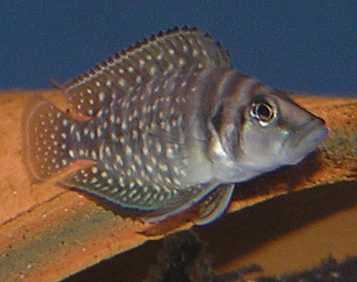
Pearly calvus
Altolamprologus calvus
Cichlidae
Moderate
Parameter dashboard
Temperature
24-27 °C
pH
7.5-9
Size
13.8 cm
Lifespan
8 years
Min tank150 L
Price$$$
DietCarnivore
TemperamentPeaceful
OriginAfrica
Shrimp-safeNo
Care guide
The pearly calvus reaches about 13.8 cm standard length and is a shell-dwelling cichlid endemic to Lake Tanganyika. The black colour variant displays a charcoal body densely covered in white pearl-like spots. The aquarium should be set up as a Tanganyikan biotope with piles of rocks forming caves, a sand substrate, and dim lighting — calvus is a shy fish that shows its best colour when it feels secure. A tank of 150 L or more can house a pair or small colony. Temperature of 24–27 °C and pH 7.5–9.0 with hard, alkaline water are essential. Diet consists of meaty live and frozen foods — bloodworm, brine shrimp, chopped prawn and mussel — as it rarely accepts dried foods. Males grow larger with longer fins. This species is territorial but peaceful toward fish it cannot eat; avoid aggressive mbuna. Suitable companions include Julidochromis, Neolamprologus, and Synodontis catfish. With patience it becomes a confident and rewarding Tanganyikan aquarium resident.
Source
Figures on this page were read off these pages. Manufacturers and databases do change or retire pages; if a link is dead, tell us with the correction link below.
Tankmate compatibility (sample)
Pairwise screening against other species in the database (prioritizing the same family when data is available).
Review first (10)
Caution or avoid from automated rules — confirm before mixing.
| Species | Assessment | Notes |
|---|---|---|
| Bluegray mbuna Melanochromis johannii Caution | Caution | Multiple territorial species in the same swim layer cause stress Open pair in Compare → |
| Demon eartheater Satanoperca jurupari Caution | Caution | Multiple territorial species in the same swim layer cause stress · Species with non-overlapping pH ranges may not thrive together Open pair in Compare → |
| Jack Dempsey Rocio octofasciata Caution | Caution | Multiple territorial species in the same swim layer cause stress Open pair in Compare → |
| Mendezs Dwarf Cichlid Apistogramma mendezi Caution | Caution | Fish 2x+ larger may eat smaller tankmates · Multiple territorial species in the same swim layer cause stress · Species with non-overlapping pH ranges may not thrive together Open pair in Compare → |
| Multies Neolamprologus multifasciatus Caution | Caution | Fish 2x+ larger may eat smaller tankmates Open pair in Compare → |
| Oscar Astronotus ocellatus Caution | Caution | Fish 2x+ larger may eat smaller tankmates · Species with non-overlapping pH ranges may not thrive together Open pair in Compare → |
| Red Spotted Severum Heros efasciatus var. Caution | Caution | Species with non-overlapping pH ranges may not thrive together Open pair in Compare → |
| Redhump eartheater Geophagus steindachneri Caution | Caution | Species with non-overlapping pH ranges may not thrive together Open pair in Compare → |
| Panda Uaru Uaru fernandezyepezi Avoid | Avoid | Species with non-overlapping temperature ranges cannot coexist · Species with non-overlapping pH ranges may not thrive together Open pair in Compare → |
| Ram cichlid Mikrogeophagus ramirezi Avoid | Avoid | Fish 2x+ larger may eat smaller tankmates · Species with non-overlapping temperature ranges cannot coexist · Species with non-overlapping pH ranges may not thrive together Open pair in Compare → |
2 species with compatible assessment in this sampleCollapse to hide the list; use “Open pair in Compare” for the full matrix.
| Species | Assessment | Notes |
|---|---|---|
| Biajaca Nandopsis tetracanthus Compatible | Compatible | No rule-based conflicts detected for this pair. Open pair in Compare → |
| Yellow belly cichlid Cichlasoma salvini Compatible | Compatible | No rule-based conflicts detected for this pair. Open pair in Compare → |
Same rule engine as Compare. Not a substitute for observation, tank size, or acclimation.
Related species
Keep this species? Spot anything off?