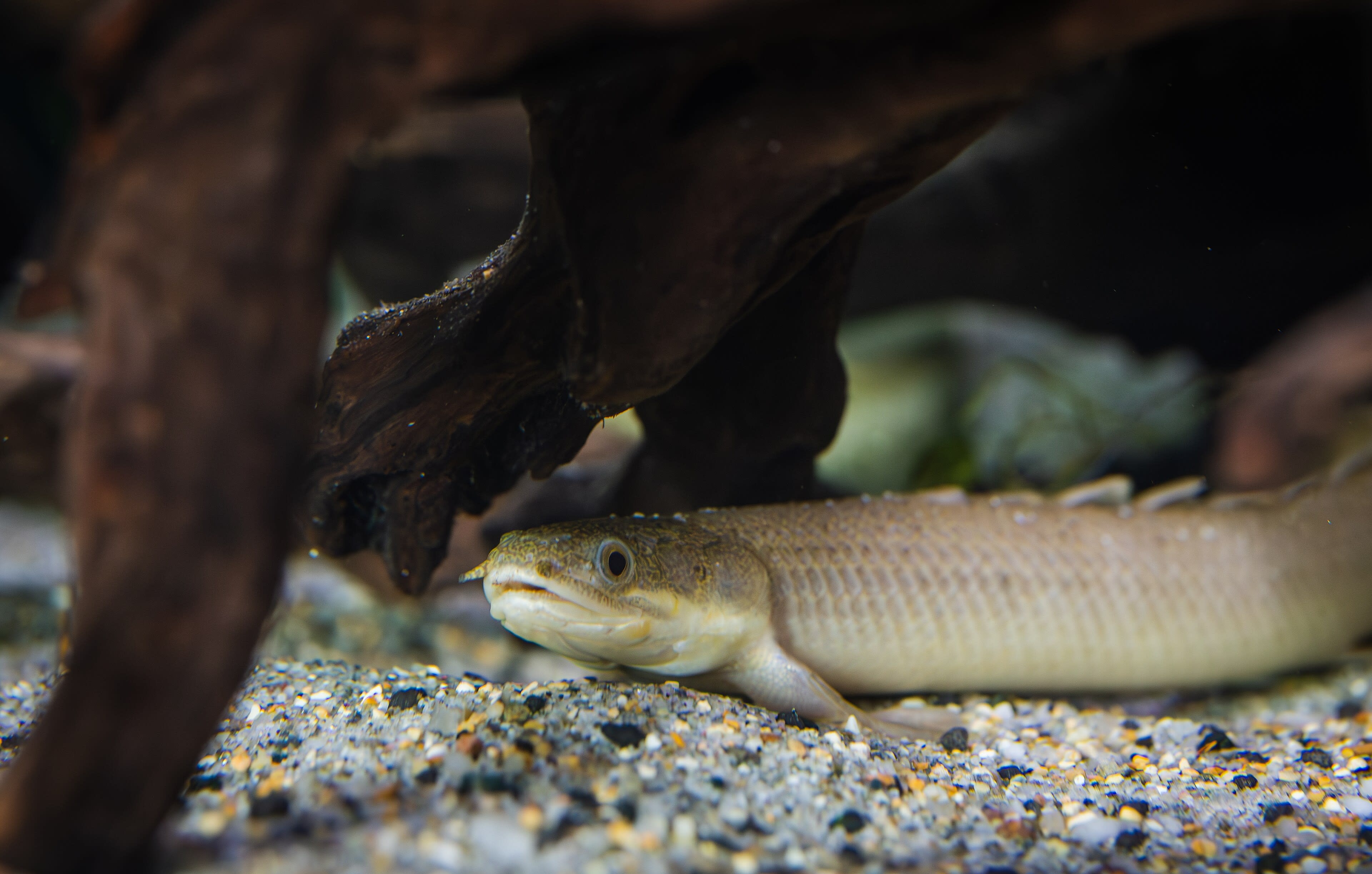
Gray bichir
Polypterus senegalus
Polypteridae
Moderate
Parameter dashboard
Temperature
25-28 °C
pH
6-8
Size
70 cm
Lifespan
15 years
Min tank200 L
Price$$$$
DietCarnivore
TemperamentSemi-aggressive
OriginAfrica
Shrimp-safeNo
Care guide
The Senegal bichir is one of the most recognisable 'living fossil' fish in the hobby, representing a lineage that dates back to the Triassic period over 200 million years ago. Adults reach up to 70 cm standard length in the wild per FishBase, though captive specimens typically grow to 30–45 cm depending on tank size and feeding. The body is elongated and eel-like, covered in thick, armour-like ganoid scales, with a flattened head, external nostrils, and a row of dorsal finlets running along the back instead of a single continuous fin. Like all bichirs, Polypterus senegalus has a pair of lungs derived from the swim bladder and must have access to atmospheric air — it will drown if prevented from reaching the surface. A 200-litre tank is the minimum considered for a single adult, but a larger volume handles the waste load of this heavy feeder much better. The footprint matters more than height: a 120×45 cm base or larger suits their bottom-dwelling, horizontal swimming style. A tight-fitting lid is mandatory; bichirs are notorious escape artists. FishBase records a temperature range of 25–28°C, with a pH of 6.0–8.0. Senegal bichirs are nocturnal predators with poor eyesight but an excellent sense of smell. They will eat anything that fits in their mouths, including smaller tankmates. They are solitary by nature and do not need company of their own kind. Feed sinking carnivore pellets, earthworms, prawns, and pieces of fish. With good care they can live 15 years or more.
Source
Figures on this page were read off these pages. Manufacturers and databases do change or retire pages; if a link is dead, tell us with the correction link below.
Tankmate compatibility (sample)
Pairwise screening against other species in the database (prioritizing the same family when data is available).
Review first (11)
Caution or avoid from automated rules — confirm before mixing.
| Species | Assessment | Notes |
|---|---|---|
| Bluegray mbuna Melanochromis johannii Caution | Caution | Fish 2x+ larger may eat smaller tankmates · Multiple territorial species in the same swim layer cause stress Open pair in Compare → |
| Crescent betta Betta imbellis Caution | Caution | Fish 2x+ larger may eat smaller tankmates Open pair in Compare → |
| Desert goby Chlamydogobius eremius Caution | Caution | Fish 2x+ larger may eat smaller tankmates Open pair in Compare → |
| Gold Nugget Pleco Baryancistrus xanthellus Caution | Caution | Fish 2x+ larger may eat smaller tankmates · Multiple territorial species in the same swim layer cause stress Open pair in Compare → |
| Malabar pufferfish Carinotetraodon travancoricus Caution | Caution | Fish 2x+ larger may eat smaller tankmates · Multiple territorial species in the same swim layer cause stress Open pair in Compare → |
| Red phantom tetra Hyphessobrycon sweglesi Caution | Caution | Fish 2x+ larger may eat smaller tankmates Open pair in Compare → |
| Sailfin molly Poecilia latipinna Caution | Caution | Fish 2x+ larger may eat smaller tankmates Open pair in Compare → |
| Zebra Archerfish Toxotes blythii Caution | Caution | Fish 2x+ larger may eat smaller tankmates Open pair in Compare → |
| Asian Stone Catfish Hara jerdoni Avoid | Avoid | Fish 2x+ larger may eat smaller tankmates · Species with non-overlapping temperature ranges cannot coexist Open pair in Compare → |
| Pond loach Misgurnus anguillicaudatus Avoid | Avoid | Fish 2x+ larger may eat smaller tankmates · Species with non-overlapping temperature ranges cannot coexist Open pair in Compare → |
| Small snakehead Channa asiatica Avoid | Avoid | Fish 2x+ larger may eat smaller tankmates · Multiple territorial species in the same swim layer cause stress · Species with non-overlapping temperature ranges cannot coexist Open pair in Compare → |
1 species with compatible assessment in this sampleCollapse to hide the list; use “Open pair in Compare” for the full matrix.
| Species | Assessment | Notes |
|---|---|---|
| Finescale tigerfish Datnioides microlepis Compatible | Compatible | No rule-based conflicts detected for this pair. Open pair in Compare → |
Same rule engine as Compare. Not a substitute for observation, tank size, or acclimation.
Keep this species? Spot anything off?