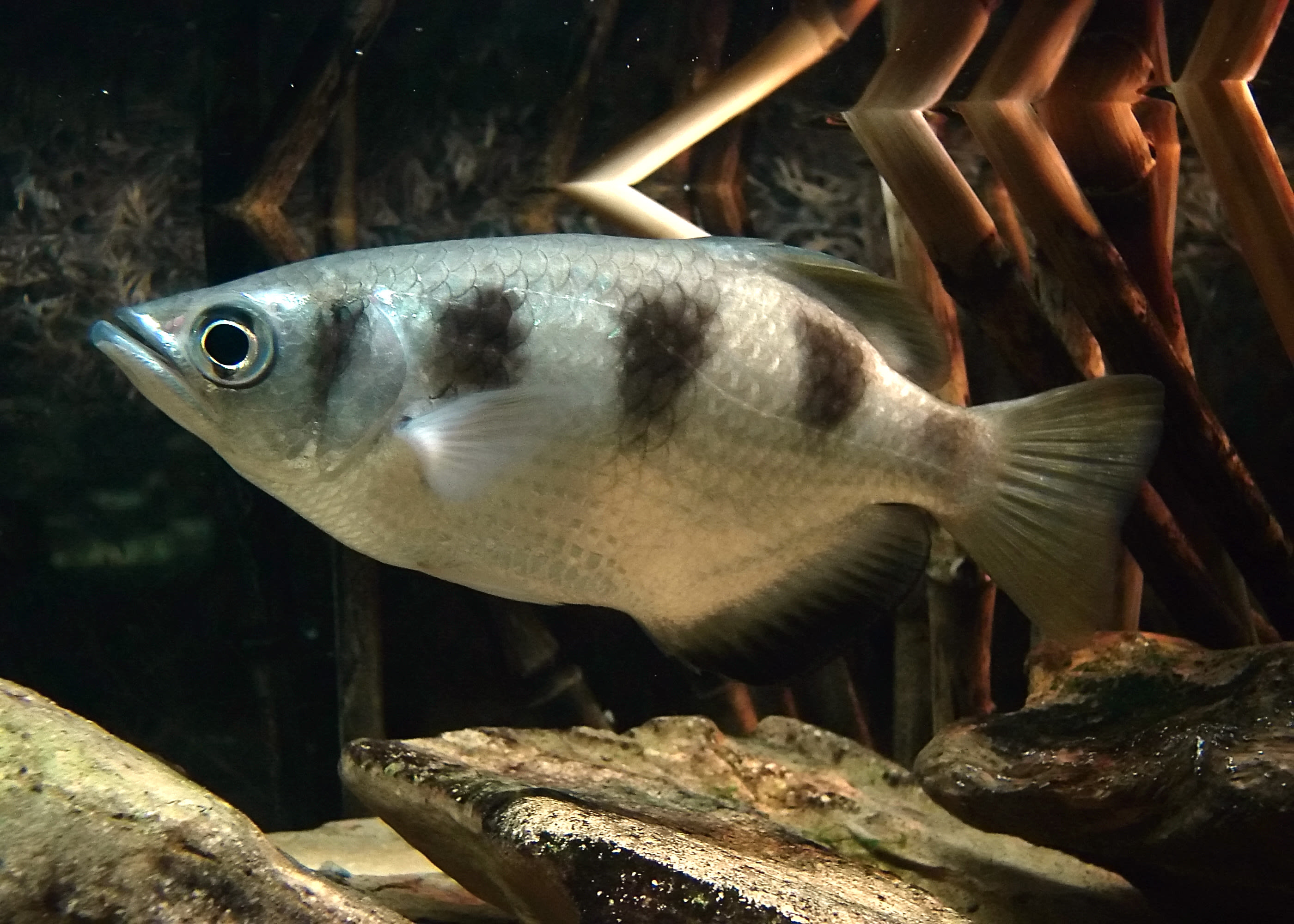
Zebra Archerfish
Toxotes blythii
Toxotidae
Moderate
Parameter dashboard
Temperature
25-28 °C
pH
6.5-8
Size
15 cm
Lifespan
10 years
Min tank350 L
Price$$$
DietCarnivore
TemperamentSemi-aggressive
OriginAsia
Shrimp-safeNo
Care guide
Toxotes blythii is the archerfish you can keep in plain fresh water, and the least commonly seen member of its genus in the trade. It comes from a restricted part of Burma that is hard to reach, so collecting trips are rare and the fish only began appearing on exporters' lists recently. It is sold as both the zebra and the clouded archerfish, the first name referring to the dark vertical bars along its flanks, which are boldest in young specimens. Adult size is not firmly established; Practical Fishkeeping puts it at roughly 15 cm, with the caveat that nobody is certain. Unlike the brackish T. jaculatrix and T. chatareus, this species does not need salt in its water, though it tolerates salt well enough for that to be useful when treating whitespot or velvet. Like all archerfish it shoots a jet of water at insects above the surface, which is the whole reason to keep one. A group of three or four wants 350 litres, and three is the sensible floor for a group because a pair usually ends with the dominant fish bullying the other to death. A single specimen can be housed in 200 litres and does fine, if a little shy. Water should be 25–28°C at pH 6.5–8.0, well oxygenated with a decent current, and shaded at the surface by floating plants. A tight lid is non-negotiable: all archers jump. These are predators that can swallow prey up to about half their own length, so pick tankmates on that basis and avoid anything boisterous or nippy. Wild fish eat insects, spiders, crustaceans and small fish; captive ones take floating pellets and frozen foods greedily. Their breeding biology is entirely undocumented.
Source
Figures on this page were read off these pages. Manufacturers and databases do change or retire pages; if a link is dead, tell us with the correction link below.
Tankmate compatibility (sample)
Pairwise screening against other species in the database (prioritizing the same family when data is available).
Review first (9)
Caution or avoid from automated rules — confirm before mixing.
| Species | Assessment | Notes |
|---|---|---|
| Black ruby barb Pethia nigrofasciata Caution | Caution | Fish 2x+ larger may eat smaller tankmates Open pair in Compare → |
| Buenos Aires tetra Hyphessobrycon anisitsi Caution | Caution | Fish 2x+ larger may eat smaller tankmates Open pair in Compare → |
| Finescale tigerfish Datnioides microlepis Caution | Caution | Fish 2x+ larger may eat smaller tankmates Open pair in Compare → |
| Panda Uaru Uaru fernandezyepezi Caution | Caution | Species with non-overlapping pH ranges may not thrive together Open pair in Compare → |
| Pygmy corydoras Corydoras pygmaeus Caution | Caution | Fish 2x+ larger may eat smaller tankmates Open pair in Compare → |
| Reticulated hillstream loach Sewellia lineolata Avoid | Avoid | Fish 2x+ larger may eat smaller tankmates · Species with non-overlapping temperature ranges cannot coexist Open pair in Compare → |
| Reticulated Sae Crossocheilus reticulatus Avoid | Avoid | Species with non-overlapping temperature ranges cannot coexist Open pair in Compare → |
| Ruby barb Pethia padamya Avoid | Avoid | Fish 2x+ larger may eat smaller tankmates · Species with non-overlapping temperature ranges cannot coexist Open pair in Compare → |
| Zebra danio Danio rerio Avoid | Avoid | Fish 2x+ larger may eat smaller tankmates · Species with non-overlapping temperature ranges cannot coexist Open pair in Compare → |
3 species with compatible assessment in this sampleCollapse to hide the list; use “Open pair in Compare” for the full matrix.
| Species | Assessment | Notes |
|---|---|---|
| Congo tetra Phenacogrammus interruptus Compatible | Compatible | No rule-based conflicts detected for this pair. Open pair in Compare → |
| Pearl gourami Trichopodus leerii Compatible | Compatible | No rule-based conflicts detected for this pair. Open pair in Compare → |
| Pearly calvus Altolamprologus calvus Compatible | Compatible | No rule-based conflicts detected for this pair. Open pair in Compare → |
Same rule engine as Compare. Not a substitute for observation, tank size, or acclimation.
Keep this species? Spot anything off?