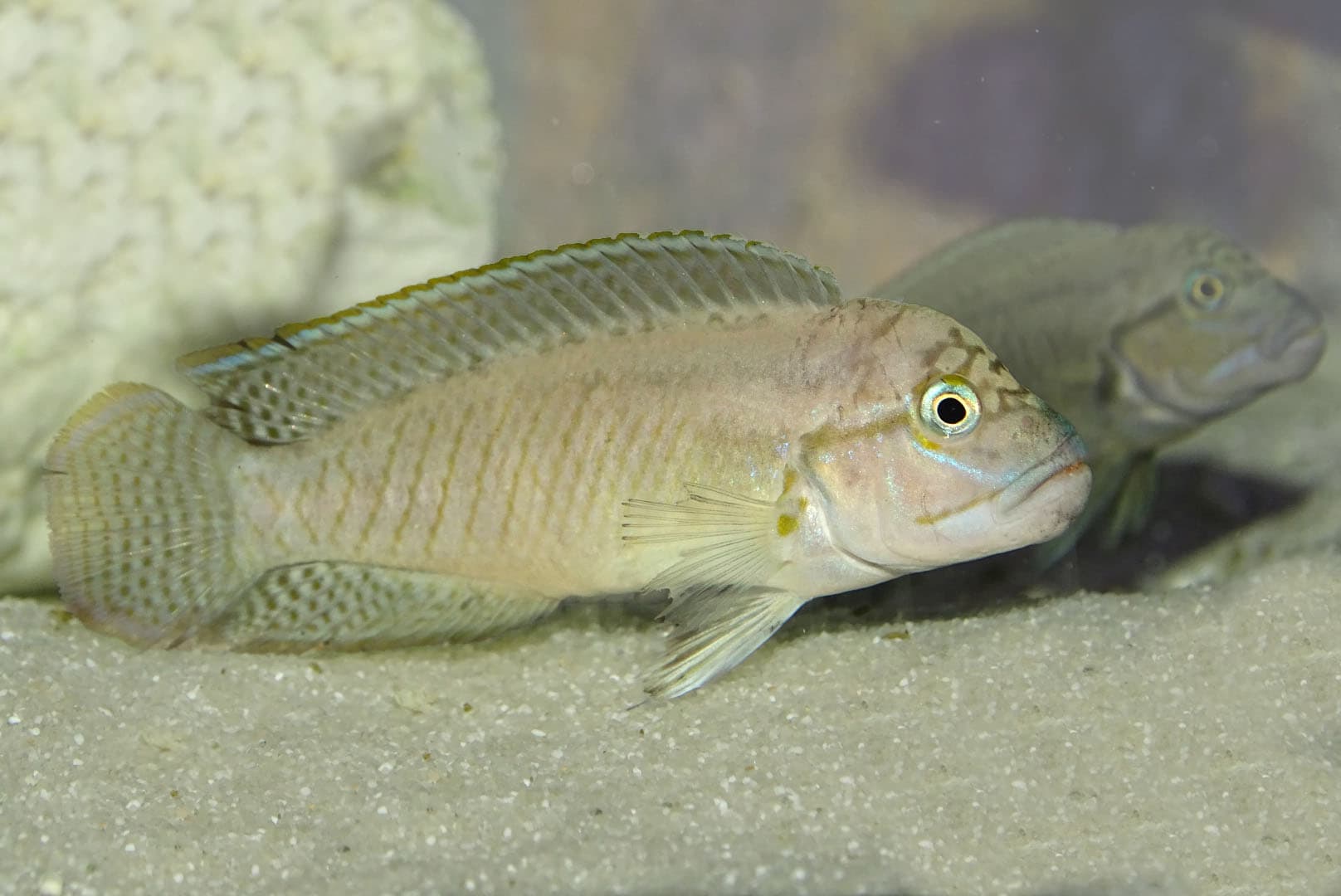
Temporaris Shell Dweller
Telmatochromis temporalis
Cichlidae
Moderate
Parameter dashboard
Temperature
24-27 °C
pH
8-9
Size
4.4 cm
Lifespan
8 years
Min tank80 L
Price$$$
DietOmnivore
TemperamentSemi-aggressive
OriginAfrica
Shrimp-safeNo
Care guide
Telmatochromis temporalis "shell" is a dwarf cichlid endemic to Lake Tanganyika in East Africa. Unlike the larger, rock-dwelling form of T. temporalis, this variant is a facultative shell-brooder that inhabits the lake's sandy shelf zones, using empty Neothauma snail shells as shelters and spawning sites. Males reach about 4.4 cm (1.7 in), with females smaller. The body is deep and oval with subtle brown–grey colouration and faint vertical bars; males develop more intense colour and slightly extended fins during breeding.
This species demands the hard, alkaline water characteristic of the Lake Tanganyika biotope: pH 8.0–9.0, GH/KH above 15°, and stable temperature at 25–26°C. A tank of at least 80 L (20 gal) for a single pair is recommended, with fine sand substrate to allow digging and a generous supply of empty escargot or similar large shells — one per fish plus spares. Rock piles and caves provide additional cover and help break sight lines when keeping a small colony in larger tanks.
Males can be aggressive toward conspecifics, especially in smaller quarters. A single pair in a dedicated shell-dweller tank is the safest option; a group in a 150 L+ (40 gal+) tank with ample floor space and visual barriers may also work. They feed on aufwuchs, insect larvae, tiny crustaceans, and biofilm in the wild. In the aquarium offer high-quality sinking cichlid pellets with algae content, supplemented with live and frozen brine shrimp, Daphnia, and bloodworms plus spirulina or blanched vegetables. Breeding is reliable in good conditions: the female lays 20–30 eggs inside a shell; both parents guard the brood. Fry hatch in 4–6 days and accept baby brine shrimp. Lifespan is 8–10 years with proper care.
Source
Figures on this page were read off these pages. Manufacturers and databases do change or retire pages; if a link is dead, tell us with the correction link below.
Tankmate compatibility (sample)
Pairwise screening against other species in the database (prioritizing the same family when data is available).
Review first (11)
Caution or avoid from automated rules — confirm before mixing.
| Species | Assessment | Notes |
|---|---|---|
| Bluegray mbuna Melanochromis johannii Caution | Caution | Fish 2x+ larger may eat smaller tankmates Open pair in Compare → |
| Freshwater angelfish Pterophyllum scalare Caution | Caution | Fish 2x+ larger may eat smaller tankmates · Multiple territorial species in the same swim layer cause stress · Species with non-overlapping pH ranges may not thrive together Open pair in Compare → |
| Gold severum Heros efasciatus var. Caution | Caution | Fish 2x+ larger may eat smaller tankmates · Multiple territorial species in the same swim layer cause stress · Species with non-overlapping pH ranges may not thrive together Open pair in Compare → |
| Greenstreaked eartheater Biotodoma cupido Caution | Caution | Fish 2x+ larger may eat smaller tankmates · Multiple territorial species in the same swim layer cause stress · Species with non-overlapping pH ranges may not thrive together Open pair in Compare → |
| Livingstonii Cichlid Nimbochromis livingstonii Caution | Caution | Fish 2x+ larger may eat smaller tankmates · Multiple territorial species in the same swim layer cause stress Open pair in Compare → |
| Malawi eyebiter Dimidiochromis compressiceps Caution | Caution | Fish 2x+ larger may eat smaller tankmates · Multiple territorial species in the same swim layer cause stress Open pair in Compare → |
| Pearly calvus Altolamprologus calvus Caution | Caution | Fish 2x+ larger may eat smaller tankmates Open pair in Compare → |
| Princess of Burundi Neolamprologus brichardi Caution | Caution | Fish 2x+ larger may eat smaller tankmates · Multiple territorial species in the same swim layer cause stress Open pair in Compare → |
| Red Spotted Severum Heros efasciatus var. Caution | Caution | Fish 2x+ larger may eat smaller tankmates · Multiple territorial species in the same swim layer cause stress · Species with non-overlapping pH ranges may not thrive together Open pair in Compare → |
| Redhump eartheater Geophagus steindachneri Caution | Caution | Fish 2x+ larger may eat smaller tankmates · Multiple territorial species in the same swim layer cause stress · Species with non-overlapping pH ranges may not thrive together Open pair in Compare → |
| Venustus Cichlid Nimbochromis venustus Caution | Caution | Fish 2x+ larger may eat smaller tankmates · Multiple territorial species in the same swim layer cause stress Open pair in Compare → |
1 species with compatible assessment in this sampleCollapse to hide the list; use “Open pair in Compare” for the full matrix.
| Species | Assessment | Notes |
|---|---|---|
| Gold Cap Caudopunctatus Neolamprologus caudopunctatus Compatible | Compatible | No rule-based conflicts detected for this pair. Open pair in Compare → |
Same rule engine as Compare. Not a substitute for observation, tank size, or acclimation.
Related species
Keep this species? Spot anything off?