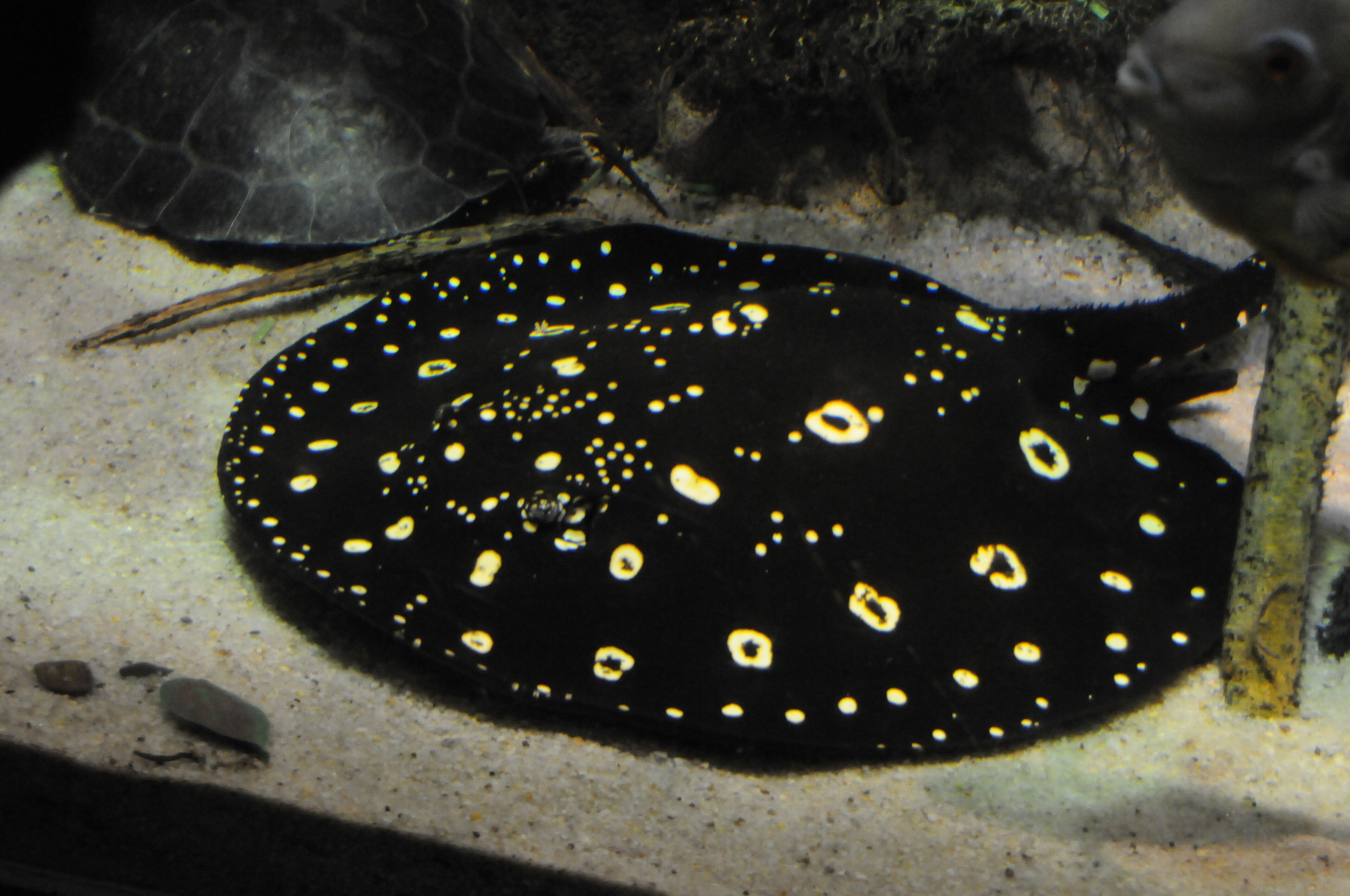
Bigtooth river stingray
Potamotrygon henlei
Potamotrygonidae
Expert
Parameter dashboard
Temperature
23-28 °C
pH
6-7.5
Size
60 cm
Lifespan
20 years
Min tank1728 L
Price$$$$
DietCarnivore
TemperamentSemi-aggressive
OriginRio Tocantins basin, Brazil
Shrimp-safeNo
Care guide
The black stingray, traded as P12 and also called the bigtooth river stingray, is probably endemic to the Rio Tocantins basin in Brazil, where it uses sand banks, the shallows of large rivers and slow tributaries over mud or sand, moving into flooded forest in the wet season and staying behind in the pools the flood leaves. A full-grown fish reaches about 60 cm standard length, with FishBase recording disc widths to 45 cm, putting it among the largest freshwater rays kept in aquaria. Brazilian exports are now illegal under IBAMA regulations, so captive-bred fish appear only occasionally and command very high prices. Colour forms vary, with white or yellow spots over a background from black to dark brown.
This is a species measured in metres. Something around 240 by 120 by 60 cm, about 1728 litres, is what a grown specimen needs, and that would also hold a pair. Filtration is the critical piece: a sump is the better arrangement because it keeps equipment out of reach and stops a ray burning itself on a submerged heater, and the turnover should be around four times the tank volume an hour with the outflow placed to agitate the surface. Weekly water changes of about 50 percent are standard. Sand is worth providing even though bare glass is easier to clean, because rays bury themselves when stressed. Rooted plants get eaten.
Keep the water at 23 to 28 °C, pH 6.0 to 7.5, preferably below neutral, and 2 to 12 dGH. Rays have a high metabolic rate and need feeding at least twice a day on whole mussels, cockles, prawns and earthworms, which makes them expensive to keep well. Never feed mammal meat such as beef heart or chicken: the lipids cannot be properly metabolised and cause fat deposits and organ degeneration. The tail spine is venomous, and a feeding ray may breach half its body above the surface, so a tight cover is a safety measure as much as an escape-proofing one.
Sources
- seriouslyfish.com — https://www.seriouslyfish.com/species/potamotrygon-henlei/
- fishbase.se — https://www.fishbase.se/summary/Potamotrygon-henlei.html
Figures on this page were read off these pages. Manufacturers and databases do change or retire pages; if a link is dead, tell us with the correction link below.
Tankmate compatibility (sample)
Pairwise screening against other species in the database (prioritizing the same family when data is available).
Review first (11)
Caution or avoid from automated rules — confirm before mixing.
| Species | Assessment | Notes |
|---|---|---|
| Blue gularis Fundulopanchax sjostedti Caution | Caution | Fish 2x+ larger may eat smaller tankmates Open pair in Compare → |
| Chili Rasbora Boraras brigittae Caution | Caution | Fish 2x+ larger may eat smaller tankmates Open pair in Compare → |
| Desert goby Chlamydogobius eremius Caution | Caution | Fish 2x+ larger may eat smaller tankmates Open pair in Compare → |
| Harlequin rasbora Trigonostigma heteromorpha Caution | Caution | Fish 2x+ larger may eat smaller tankmates Open pair in Compare → |
| Jack Dempsey Rocio octofasciata Caution | Caution | Fish 2x+ larger may eat smaller tankmates Open pair in Compare → |
| Javanese ricefish Oryzias javanicus Caution | Caution | Fish 2x+ larger may eat smaller tankmates Open pair in Compare → |
| Madagascar Rainbow Bedotia madagascarensis Caution | Caution | Fish 2x+ larger may eat smaller tankmates Open pair in Compare → |
| Orange Fin Danio Danio kyathit Caution | Caution | Fish 2x+ larger may eat smaller tankmates Open pair in Compare → |
| Panda Loach Yaoshania pachychilus Caution | Caution | Fish 2x+ larger may eat smaller tankmates Open pair in Compare → |
| Red Wolf Fish Erythrinus erythrinus Caution | Caution | Fish 2x+ larger may eat smaller tankmates Open pair in Compare → |
| South American freshwater stingray Potamotrygon motoro Caution | Caution | Species with non-overlapping pH ranges may not thrive together Open pair in Compare → |
1 species with compatible assessment in this sampleCollapse to hide the list; use “Open pair in Compare” for the full matrix.
| Species | Assessment | Notes |
|---|---|---|
| Royal panaque Panaque nigrolineatus Compatible | Compatible | No rule-based conflicts detected for this pair. Open pair in Compare → |
Same rule engine as Compare. Not a substitute for observation, tank size, or acclimation.
Related species
Keep this species? Spot anything off?