Royal panaque
Panaque nigrolineatus
Loricariidae
Hard
Parameter dashboard
Temperature
22-30 °C
pH
6.5-7.5
Size
43 cm
Lifespan
15 years
Min tank450 L
Price$$$$
DietHerbivore
TemperamentPeaceful
OriginSouth America
Shrimp-safeNo
Care guide
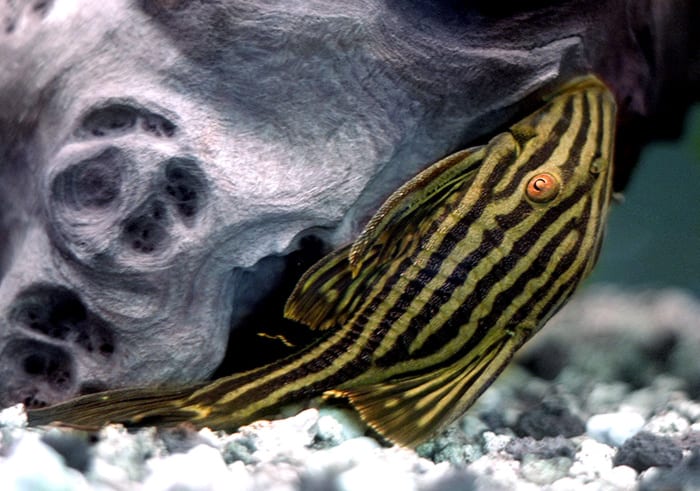
The royal pleco, traded as L190, reaches 430 mm standard length and is one of the few large loricariids a home aquarist can reasonably keep for decades. It was described from the Guarico River at Calabozo in the Apure drainage of Venezuela, and the genus ranges through the Orinoco and the southern tributaries of the middle and lower Amazon. Panaque is identified by its teeth, which are spoon-shaped and noticeably wider at the tip than at the base, and by the absence of a buccal papilla inside the mouth. Fish arrive in the trade at all sizes and in several colour forms, with eyes running from bright orange to dull red, and the forms sold as L027 come from the Tocantins, Xingu and Tapajos rather than from Venezuela.
Bogwood is not decoration for this species. It is the preferred hiding place and, by the reports its catalogue entry records, part of the diet as well. Around the wood, feed the classic pleco menu of greens: most vegetables are accepted after acclimation, tinned peas are a particular favourite, and prepared foods fill the gaps. Keep the water between 22 and 30 °C at pH 6.5 to 7.5, and expect a large adult to rearrange the tank, so anchor any rock that could topple.
Temperament is easy to misread. A royal pleco is territorial towards its own kind and towards catfish of similar size, yet peaceful with smaller fish, and it is secretive enough that a tank of active midwater fish gives you something to watch while it hides. It can also be a fussy feeder, so settle it in and get it eating before introducing large boisterous tankmates. Breeding is essentially undocumented. No published account exists, though captive spawning has been reported from a very large tank using a tube, a two-week false dry season of low warm still water, and a top-off with cooler rainwater afterwards. Sexing is undocumented too.
Source
Figures on this page were read off these pages. Manufacturers and databases do change or retire pages; if a link is dead, tell us with the correction link below.
Tankmate compatibility (sample)
Pairwise screening against other species in the database (prioritizing the same family when data is available).
Review first (9)
Caution or avoid from automated rules — confirm before mixing.
| Species | Assessment | Notes |
|---|---|---|
| Common otocinclus Otocinclus vittatus Caution | Caution | Fish 2x+ larger may eat smaller tankmates Open pair in Compare → |
| Nannoptopoma Nannoptopoma sternoptychum Caution | Caution | Fish 2x+ larger may eat smaller tankmates Open pair in Compare → |
| Oxyropsis Oxyropsis carinata Caution | Caution | Fish 2x+ larger may eat smaller tankmates Open pair in Compare → |
| Royal Farlowella Sturisomatichthys festivus Caution | Caution | Fish 2x+ larger may eat smaller tankmates Open pair in Compare → |
| Twig Catfish Farlowella vittata Caution | Caution | Fish 2x+ larger may eat smaller tankmates Open pair in Compare → |
| Whiptail catfish Farlowella acus Caution | Caution | Fish 2x+ larger may eat smaller tankmates Open pair in Compare → |
| Whiptail Catfish Loricaria simillima Caution | Caution | Fish 2x+ larger may eat smaller tankmates Open pair in Compare → |
| Zebra Oto Otocinclus cocama Caution | Caution | Fish 2x+ larger may eat smaller tankmates Open pair in Compare → |
| Zebra pleco Hypancistrus zebra Caution | Caution | Fish 2x+ larger may eat smaller tankmates Open pair in Compare → |
3 species with compatible assessment in this sampleCollapse to hide the list; use “Open pair in Compare” for the full matrix.
| Species | Assessment | Notes |
|---|---|---|
| Blue-eye panaque Panaque suttonorum Compatible | Compatible | No rule-based conflicts detected for this pair. Open pair in Compare → |
| Gold Nugget Pleco Baryancistrus xanthellus Compatible | Compatible | No rule-based conflicts detected for this pair. Open pair in Compare → |
| Sunshine Pleco Scobinancistrus aureatus Compatible | Compatible | No rule-based conflicts detected for this pair. Open pair in Compare → |
Same rule engine as Compare. Not a substitute for observation, tank size, or acclimation.
Related species
Keep this species? Spot anything off?