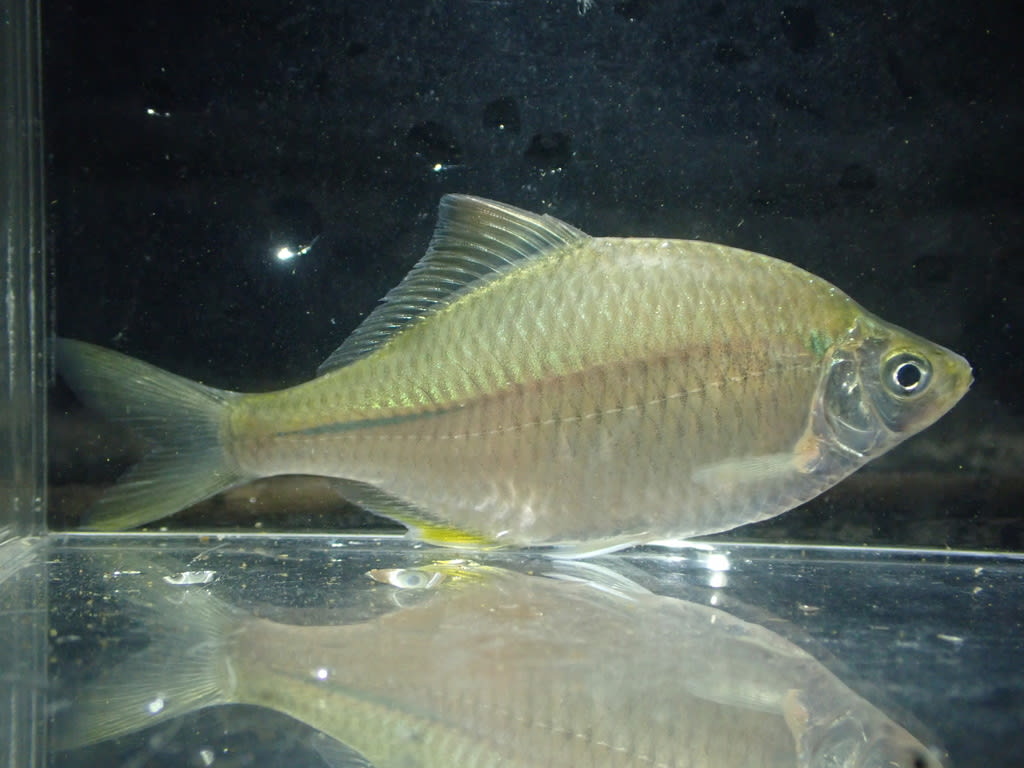
Chinese Bitterling
Rhodeus ocellatus
Cyprinidae
Moderate
Parameter dashboard
Temperature
18-24 °C
pH
6.5-7
Size
9.2 cm
Lifespan
5 years
Min tank80 L
Price$$$
DietOmnivore
TemperamentPeaceful
OriginEast Asia (China, Japan, Korea, Taiwan)
Shrimp-safeYes
Care guide
The Chinese or rosy bitterling is a small subtropical cyprinid reaching 9.2 cm standard length, though a common adult is closer to 5.2 cm. It lives in shallow ponds and plain marshes across eastern Asia and Taiwan, extends into Russia, and turns up in the irrigation canals that connect those waters. It has been introduced well beyond that native range, and at least one country reports adverse ecological effects from those introductions. The IUCN currently lists the species as Data Deficient. Males take on the rosy flush that gives the fish its other common name when they come into breeding condition.
This is a cool-water fish rather than a tropical one, and that single fact decides most of its husbandry. FishBase gives 18 to 24 °C, a pH ceiling of 7.0 with no lower bound published, and a hardness of 10 to 15 dGH. A moderately planted tank of around 80 litres suits a small group, and tankmates should be other temperate species rather than the usual tropical community. Feeding is undemanding, since the fish is omnivorous and takes prepared foods readily.
What makes bitterlings worth keeping is how they breed. The female lays her eggs inside a living freshwater mussel, the male fertilises them there, and the young stay inside the bivalve until they are able to swim out. No mussel means no fry, so a breeding project turns into a question of keeping the mussel alive as much as the fish, and that is the part most aquarists underestimate before they start.
Source
Figures on this page were read off these pages. Manufacturers and databases do change or retire pages; if a link is dead, tell us with the correction link below.
Tankmate compatibility (sample)
Pairwise screening against other species in the database (prioritizing the same family when data is available).
Review first (6)
Caution or avoid from automated rules — confirm before mixing.
| Species | Assessment | Notes |
|---|---|---|
| Dwarf rasbora Boraras maculatus Caution | Caution | Fish 2x+ larger may eat smaller tankmates · Species with non-overlapping pH ranges may not thrive together Open pair in Compare → |
| Harlequin rasbora Trigonostigma heteromorpha Caution | Caution | Fish 2x+ larger may eat smaller tankmates Open pair in Compare → |
| Red Cherry Rasbora Rasbora lacrimula Caution | Caution | Fish 2x+ larger may eat smaller tankmates Open pair in Compare → |
| Ruby barb Pethia padamya Caution | Caution | Fish 2x+ larger may eat smaller tankmates Open pair in Compare → |
| Sawbwa barb Sawbwa resplendens Caution | Caution | Fish 2x+ larger may eat smaller tankmates Open pair in Compare → |
| Strawberry Rasbora Boraras naevus Caution | Caution | Fish 2x+ larger may eat smaller tankmates Open pair in Compare → |
6 species with compatible assessment in this sampleCollapse to hide the list; use “Open pair in Compare” for the full matrix.
| Species | Assessment | Notes |
|---|---|---|
| Black ruby barb Pethia nigrofasciata Compatible | Compatible | No rule-based conflicts detected for this pair. Open pair in Compare → |
| Cherry barb Puntius titteya Compatible | Compatible | No rule-based conflicts detected for this pair. Open pair in Compare → |
| Clown rasbora Rasbora kalochroma Compatible | Compatible | No rule-based conflicts detected for this pair. Open pair in Compare → |
| Panda Garra Garra flavatra Compatible | Compatible | No rule-based conflicts detected for this pair. Open pair in Compare → |
| Reticulated Sae Crossocheilus reticulatus Compatible | Compatible | No rule-based conflicts detected for this pair. Open pair in Compare → |
| Slender Bitterling Tanakia himantegus Compatible | Compatible | No rule-based conflicts detected for this pair. Open pair in Compare → |
Same rule engine as Compare. Not a substitute for observation, tank size, or acclimation.
Related species
Keep this species? Spot anything off?