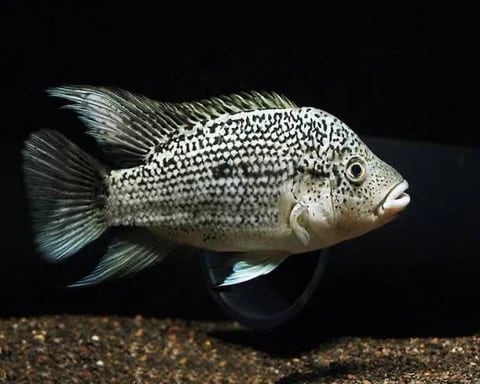
Haitian cichlid
Nandopsis haitiensis
Cichlidae
Hard
Parameter dashboard
Temperature
24-27 °C
pH
7-8
Size
21.5 cm
Lifespan
12 years
Min tank400 L
Price$$$$
DietOmnivore
TemperamentAggressive
OriginCentral America
Shrimp-safeNo
Care guide
The Haitian cichlid — the 'black nasty' to people who keep it — is the only cichlid native to Hispaniola, the island shared by Haiti and the Dominican Republic. Isolated there for millions of years, it turns up across an unusually wide range of habitats, from mountain streams and lakes to brackish coastal lagoons. Wild fish reach about 21.5 cm; in aquaria, well-fed males grow noticeably larger and develop a heavy nuchal hump.
The name is earned. This is one of the most aggressive freshwater fish in the hobby, and it will kill tankmates two or three times its size. In practice it is kept as a solitary wet pet; a bonded pair is only realistic in a very large, heavily broken-up tank, and an ordinary community is out of the question. Plan on at least a 400 litre tank for one fish, with strong filtration, a sand or fine-gravel floor and rockwork that breaks up the sightlines.
Water should be hard and alkaline, 24–27 °C, pH 7.0–8.0, and kept stable — sudden swings can trigger bloat. Diet matters more than people expect: this is really an omnivore that leans herbivorous, feeding in the wild on algae, plants and snails, so the staple should be spirulina-based rather than a rich carnivore food. Too much protein is the usual cause of bloat. It spawns readily on a cleaned flat surface, laying 150 to 200 eggs that hatch in three to four days, with both parents guarding the young.
Sources
- fishbase.se — https://www.fishbase.se/summary/Nandopsis-haitiensis.html
- aquariumglaser.de — https://www.aquariumglaser.de/en/fisharchive/nandopsis-haitiensis-2/
Figures on this page were read off these pages. Manufacturers and databases do change or retire pages; if a link is dead, tell us with the correction link below.
Tankmate compatibility (sample)
Pairwise screening against other species in the database (prioritizing the same family when data is available).
Review first (6)
Caution or avoid from automated rules — confirm before mixing.
| Species | Assessment | Notes |
|---|---|---|
| Fasciatus Shell Dweller Altolamprologus fasciatus Caution | Caution | Species with non-overlapping pH ranges may not thrive together Open pair in Compare → |
| Humphead cichlid Cyphotilapia frontosa Caution | Caution | Species with non-overlapping pH ranges may not thrive together Open pair in Compare → |
| Jack Dempsey Rocio octofasciata Caution | Caution | Multiple territorial species in the same swim layer cause stress Open pair in Compare → |
| Mendezs Dwarf Cichlid Apistogramma mendezi Caution | Caution | Fish 2x+ larger may eat smaller tankmates · Multiple territorial species in the same swim layer cause stress · Species with non-overlapping pH ranges may not thrive together Open pair in Compare → |
| Pearly calvus Altolamprologus calvus Caution | Caution | Multiple territorial species in the same swim layer cause stress Open pair in Compare → |
| Ram cichlid Mikrogeophagus ramirezi Avoid | Avoid | Fish 2x+ larger may eat smaller tankmates · Species with non-overlapping temperature ranges cannot coexist · Species with non-overlapping pH ranges may not thrive together Open pair in Compare → |
6 species with compatible assessment in this sampleCollapse to hide the list; use “Open pair in Compare” for the full matrix.
| Species | Assessment | Notes |
|---|---|---|
| Malawi eyebiter Dimidiochromis compressiceps Compatible | Compatible | No rule-based conflicts detected for this pair. Open pair in Compare → |
| Moga Hypsophrys nicaraguensis Compatible | Compatible | No rule-based conflicts detected for this pair. Open pair in Compare → |
| Red Spotted Severum Heros efasciatus var. Compatible | Compatible | No rule-based conflicts detected for this pair. Open pair in Compare → |
| Redhump eartheater Geophagus steindachneri Compatible | Compatible | No rule-based conflicts detected for this pair. Open pair in Compare → |
| Rio Grande cichlid Herichthys cyanoguttatus Compatible | Compatible | No rule-based conflicts detected for this pair. Open pair in Compare → |
| Venustus Cichlid Nimbochromis venustus Compatible | Compatible | No rule-based conflicts detected for this pair. Open pair in Compare → |
Same rule engine as Compare. Not a substitute for observation, tank size, or acclimation.
Related species
Keep this species? Spot anything off?